

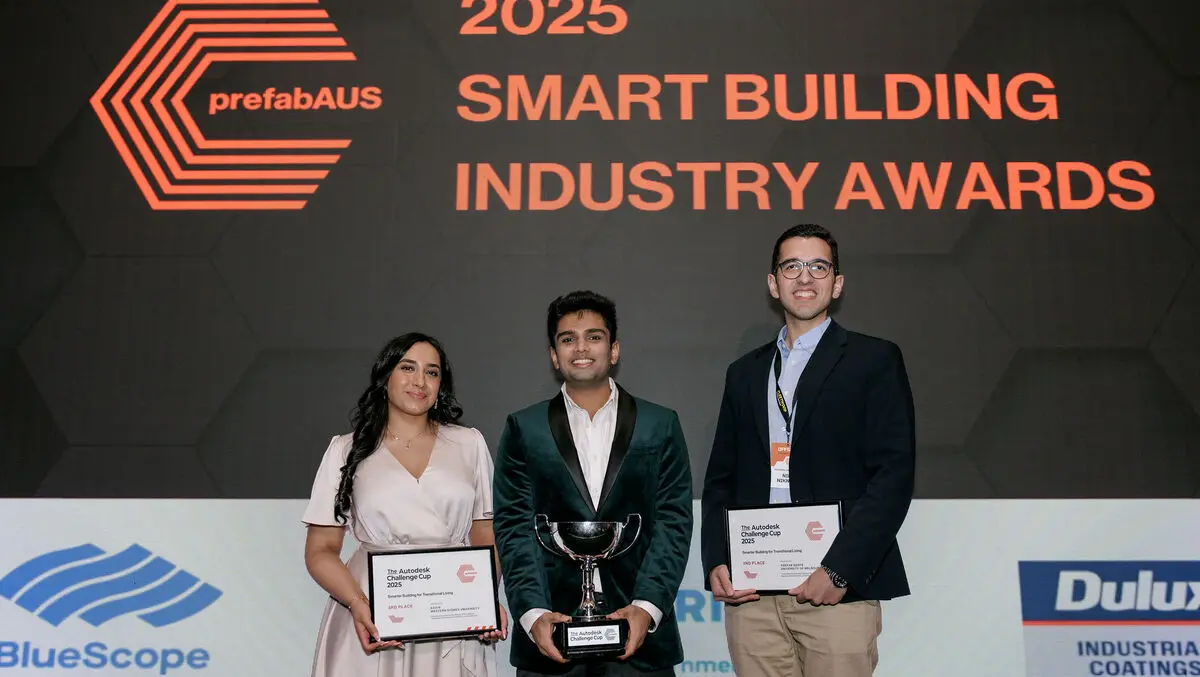
Deakin University team wins Autodesk Cup with flexible housing design
Wed, 10th Sep 2025
A student team from Deakin University Geelong has secured first place in the Autodesk Challenge Cup for their architectural project 'Solace', which applies prefabricated building techniques and universal design principles.
The competition saw participation from seven teams representing universities across Australia. The brief set for the 2025 Autodesk Challenge Cup required entrants to develop a mid-rise building, between three and six storeys, that utilised prefabricated construction to create high-quality transitional living accommodation for people with disabilities and the elderly. Designs also had to address the need for greater housing density, given current shortages nationwide.
The Challenge Cup is facilitated by the industry organisation prefabAUS in partnership with Autodesk, a provider of technology to the architecture, engineering, and construction sectors. The sixth edition of the competition aimed to encourage novel applications of prefabrication and modular methods among students studying architecture, engineering and construction management.
Winning projects
The top three teams presented their concepts to a panel of architecture, engineering, and construction professionals. Team Six Degrees from Deakin University Geelong, led by Prakhar Soam, won first place with their submission 'Solace'. Their design offers a six-storey transitional living facility on a 3,143.42 m2 site in Geelong, comprising 41 residential units configured for flexibility. The proposal addresses adaptability and social impact through prefabricated infrastructure.
The Solace design employs a "Flexi-Build system" of cross-laminated timber (CLT) floor slabs, modular steel partition walls, and hydronic ceiling panels that enhance configurability. Units are set on a 5 x 5 metre grid, allowing internal spaces to be easily merged or separated. The layout features peripheral corridors and terraces that can be converted for various uses, promoting autonomy and opportunities for social interaction.
Second place was awarded to the University of Melbourne's team Prefab GOATS for their project 'Spaces that Heal, Structure That Last'. This six-storey transitional housing proposal includes 2,600m2 of facilities for therapeutic programmes such as arts, sensory therapy, and physical rehabilitation. With 78 accessible dwellings, it is designed to support independent living and social reintegration for people facing a range of physical, cognitive, or psychosocial challenges.
The third-placed team, Axion from Western Sydney University, presented 'Circulux', a prefabricated project beside Sydney's Tallawong Metro Station in the Northwest Growth Area. The design adopts a circular form to enhance light, modularity and spatial clarity. The layout and manufacturing strategy aim for seamless accessibility by eliminating level changes and enabling step-free, continuous paths throughout the building.
Judges and organisers' perspectives
The panel of judges highlighted the quality of entries and the importance of developing accommodation models that both utilise advanced manufacturing techniques and address contemporary community needs. Damien Crough, Executive Chair of prefabAUS, outlined the significance of the challenge in the context of demographic shifts and the advancement of universal design.
"With an aging population and more understanding of the importance of universal design and access to the quality of life experienced by people living with disability, this Challenge has delivered a solution to a real-world problem. Using smart building techniques that combine digital design and advanced manufacturing techniques, mean time and waste savings and enhanced building performance are realized." said Mr Crough.
Sumit Oberoi, Senior Manager Construction Strategy, APAC at Autodesk, commented on the necessity for change in construction practices and commended the student work showcased through the finals:
"We are thrilled to announce another innovative group of finalists for the Challenge Cup. The way the AEC industry works today is not sustainable or scalable. For the industry to keep pace, it needs to build more projects in a faster and more sustainable way. The answer is industrialised construction, being able to connect design and make from day one – resulting in faster, high-quality projects with less waste."
Mr Oberoi also acknowledged the high standard of entries, saying, "The quality and level of innovation amongst teams has been incredible and we congratulate the finalists, Australia's next generation of built design professionals, on their exceptional efforts and innovation."
Focus on transitional living
The competition tasked students with designing intermediary housing solutions that bridge the gap between institutional care and independent living. The intent was to produce replicable and suitable buildings for a changing population, with flexible internal spaces and integrated assistive technologies as essential components. The use of prefabrication was central, providing scope to realise universal design outcomes and adaptive, high-quality homes in shorter timeframes and with reduced environmental impact.
This year's entries demonstrated approaches that combined architectural flexibility, user-centred design, and manufacturing considerations, highlighting prefabrication's capacity to address current and future housing challenges.