

.webp)
Rebel Wolves and Bandai Namco Entertainment take players to 14th-century Europe with The Blood of Dawnwalker, a dark fantasy action-adventure set deep in the Carpathian Mountains.
A group of Vrakhiri, vampires, has descended on the plague-stricken Vale Sangora. Isolated from the surrounding region, the vampires seize power and offer the citizens a cure for the Black Death by drinking vampiric blood. In return, the adults must surrender a pint of their own blood once every month.
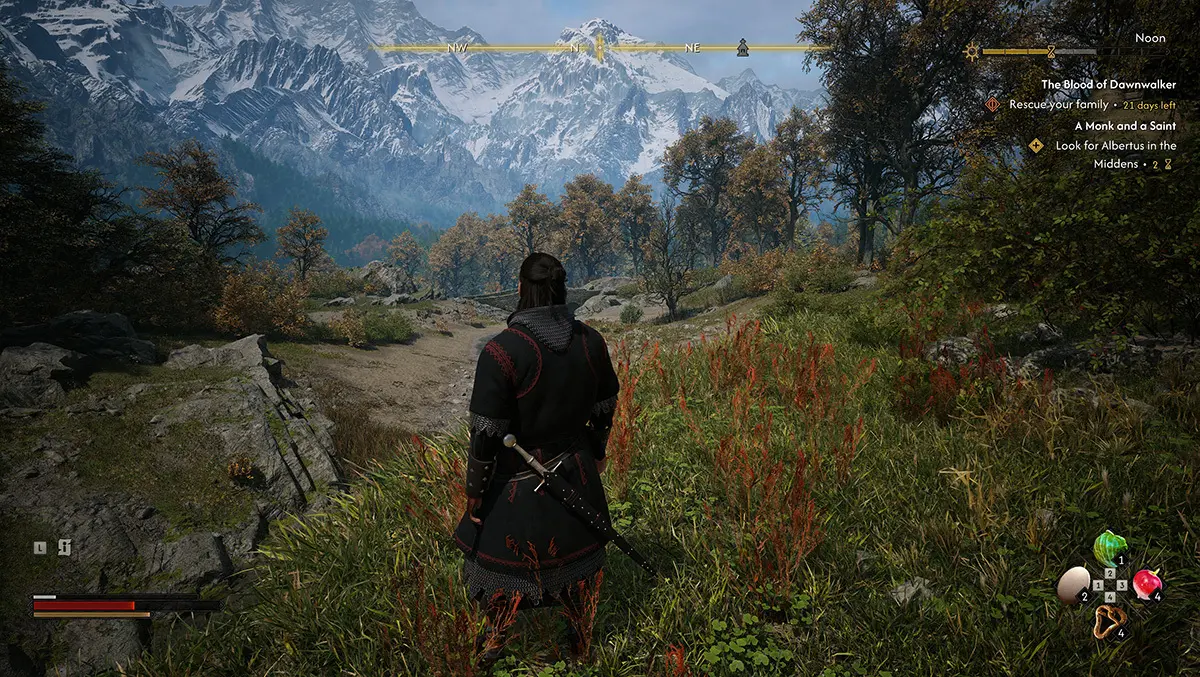
The Blood of Dawnwalker is a third-person action game that wears its shared pedigree with The Witcher 3: Wild Hunt very much on its sleeve, the two games sharing creative minds. There are obvious similarities, but it's still very much its own game.
In the mountain village of Laslea, Coen lives with his mother, father, brother and two sisters. Following the monthly blood mass, Coen gets caught up in a rebellion that leaves most of the villagers dead, his family captured, and himself afflicted with the Vrakhiri curse. A confrontation with the vampire leader, Brencis, leaves Coen, in his vampire form, pinned to a tree to die as the sun rises. Rather than burn in the sun, Coen reverts back to his human form. Not quite vampire and not quite human, Coen is the titular Dawnwalker.
Somewhat controversially, the game plays to a calendar. Players have thirty days in which to prepare to fight Brencis and free his family. Days and nights are broken down into segments. Every mission and side mission costs time segments, depending on the complexity. As you undertake missions, the time advances, day turning into night and night into day.
Now, I enjoy open-world games because of the freedom that they give me. I love taking on side quests and doing my own thing, moving the main questline along in my own time. Whilst it may be unrealistic, as this may prolong whatever calamity needs fixing, it makes for a fun game.
The way that the days tick by in The Blood of Dawnwalker added a level of stress that really didn't appeal to me at first. Instead of cleaning up side quests, I felt a panicked pressure to progress through the main questline. And this presents issues of its own, as the game requires players to upgrade Coen's abilities, else you end up against insurmountable odds. I didn't have to worry, though, as the game gave me plenty of time to reach its conclusion, even if, in my initial haste, I had to toughen up with the game's combat system.
I'm not a fan of Souls-like games. That sort of punishing grind is not for me. But give me a polished combat system that treats players fairly, without annoying surprises, and I'm up for it. And that's The Blood of Dawnwalker. You are not going to get away with spamming hits, you are going to have to think. But every defeat is on you and not some conniving game mechanic making things unnecessarily tiresome.
The game uses a strike and blocking system that requires players to match the block with the direction of the enemy strike. There is an indicator to help you (that, I believe, can be switched off if punishment is your jam). You can just omniblock without a direction, but that uses up stamina; so, you'll only get away with that a few times before you start getting sliced up.
My habit of getting into scraps with multiple enemies way above my level meant that out of necessity I got to grips with this system quickly. Matching direction blocks with directional strikes dealt more damage, especially essential with multiple opponents.
Combat, for the most part, involves several opponents. And they don't form an orderly queue; each one having a go at you concurrently. This means having your head on a swivel, blocking and striking in all directions. Some enemies throw the odd unblockable strike or artillery, which needs a dodge. Harder enemies didn't seem better at fighting; they just delivered more damage when they connected. This baptism of fire had me sometimes parrying away and dodging for a considerable amount of time waiting for my chance to carefully strike or for an essential buff to cool down.
The comparison with The Witcher 3 is inevitable. Coen is a sword-fighting supernatural being that also uses magic and potions. Preparation is key to surviving some battles. Unlocking abilities that take a sizable bite out of your enemies' health is essential.
By night Coen's ability to drink enemies' blood can not only be used to drain their health, but also replenish your own. By day, similar witchcraft can be used to attack enemies. Sword and Claw art attacks can also be triggered to even the odds. I found the combat fun, sometimes challenging, but always fair.
Fans of loot will enjoy gathering upgraded weapons, armour, trinkets and coin from corpses and treasure chests. You can also visit a blacksmith to level up your favourite equipment.
Stopping off at shrines allows you to fast travel, store items and upgrade abilities. Some shrines will need repairing via a mini-mission. When not fast travelling the game grant you with other fast methods of getting around. As a vampire, by night, once unlocked Coan can turn into a wolf and run through the environment, as long as his stamina bar lasts. By day Coen can run really fast using witchcraft, again dependant on stamina. Vampire Coen can also teleport, essential for traversing gaps and walls, particularly the tower dotted around, which unlock landmarks à la Assassin's Creed.
Coen often relies on focus mode to see enemies and other items of interest. This is similar to Geralt's tracking ability in The Witcher 3 and Eagle Vision in Assassin's Creed.
I'd be lying if I said that The Blood of Dawnwalker wasn't derivative. By day he even looks like a young Geralt of Rivia. The medieval European styling of the game, the landscape and its people are similar to that of the world of The Witcher. But that familiarity works in its favour as the game doesn't disappoint. It's not trying too hard to be like other similar games. Whilst the inspiration is there, The Blood of Dawnwalker has enough unique gameplay elements to be its own thing, building on what's come before.
The interesting premise, exciting story, well-written supporting characters, and overall feel of the game round out a remarkably polished experience. Very few games these days pique my interest to the point that I'm thinking about them when I'm not playing. I found myself genuinely looking forward to the next time I'd be playing the game. Even now, writing this, I feel like having a quick go once I've finished this review and trying some of the side missions I never got to do the first time.
The Blood of Dawnwalker is a solid game that brings as much to the table as it borrows from elsewhere. I can't wait to enjoy many more adventures with Coen of Laslea.