

OpenAudio adds KNX media metadata to HOLO-WHAS range
Tue, 15th Sep 2026.webp)
OpenAudio has added real-time media metadata support to the KNX integration in its HOLO-WHAS multi-zone audio range. The update is available in Australia and New Zealand through distributor AVOZ.
The change extends OpenAudio's KNX integration beyond basic audio commands, allowing compatible KNX control systems to display information about the content being played, including track title, artist, album, playback status and progress.
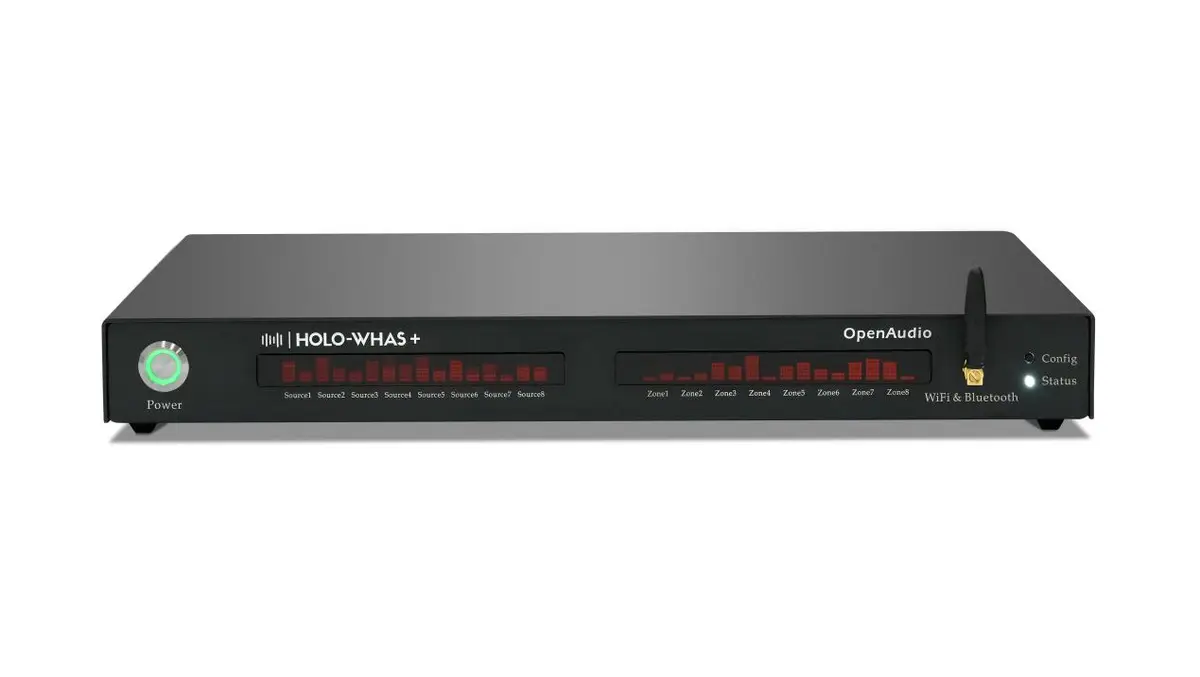
OpenAudio's HOLO-WHAS platform combines several audio functions in one unit, including streaming, amplification, matrix routing, DSP processing and automation integration. The range is built around a 16-channel design, supporting eight independent audio zones and eight streaming sources.
Until now, the KNX implementation focused on four core functions: mute, volume, source selection and audio routing. The new metadata layer allows KNX touch panels and visualisation systems to present detailed audio information rather than simple control options alone.
Instead of showing only labels such as music or audio on, a KNX interface can now display what is playing, the artist, the album and playback progress.
Broader integration
The update addresses a longstanding gap in building automation, where lighting, climate, shading and security often offer deeper visualisation than distributed audio. In many installations, users could adjust volume or switch sources, but could not view meaningful media information from the same interface.
According to Darren Ma, PhD, Business Development Director at OpenAudio, "Audio has traditionally been one of the least integrated subsystems within many building automation projects. While users could control volume and source selection, they often lacked visibility into what content was actually being played. By bringing metadata directly into the KNX ecosystem, we are helping create a more seamless and informative user experience."
The hardware is aimed at residential, hospitality and commercial settings where audio is managed across multiple rooms or areas. The system can route multiple sources independently to different zones and supports several routing arrangements across a property.
The HOLO-WHAS Plus model includes 16 x 100W of amplification for a total output of 1,600W. Depending on the model, the range offers up to 100W or 200W per channel.
Single-platform approach
OpenAudio positions the HOLO-WHAS line as an alternative to combining separate streamers, matrix processors and multi-channel amplifiers. By integrating those elements into one platform, integrators can reduce the number of devices in a system and centralise control of audio distribution.
Streaming support includes Qobuz Connect, AirPlay 2, Spotify Connect, DLNA and Bluetooth. Physical inputs include RCA, SPDIF, USB and HDMI ARC.
OpenAudio also supports what it describes as 1-to-N, M-to-1 and M-to-N routing. In practice, that allows one source to feed several zones, several sources to be directed to different zones, or groups of zones to be configured to suit the installation.
For larger projects, multiple OpenAudio units can be used within a wider centralised system. Each device supports eight zones and can be cascaded for larger installations.
Regional distribution
AVOZ has been appointed exclusive distributor for OpenAudio in Australia and New Zealand, giving it responsibility for bringing the HOLO-WHAS range and its KNX integration to the local custom installation and automation market.
The regional push comes as integrators increasingly treat audio as part of a broader automation system rather than a separate subsystem. In that context, the addition of real-time metadata is intended to make KNX panels and visualisation tools more useful as day-to-day music interfaces across homes and other buildings.
The latest KNX metadata support is delivered through the current OpenAudio firmware release.