

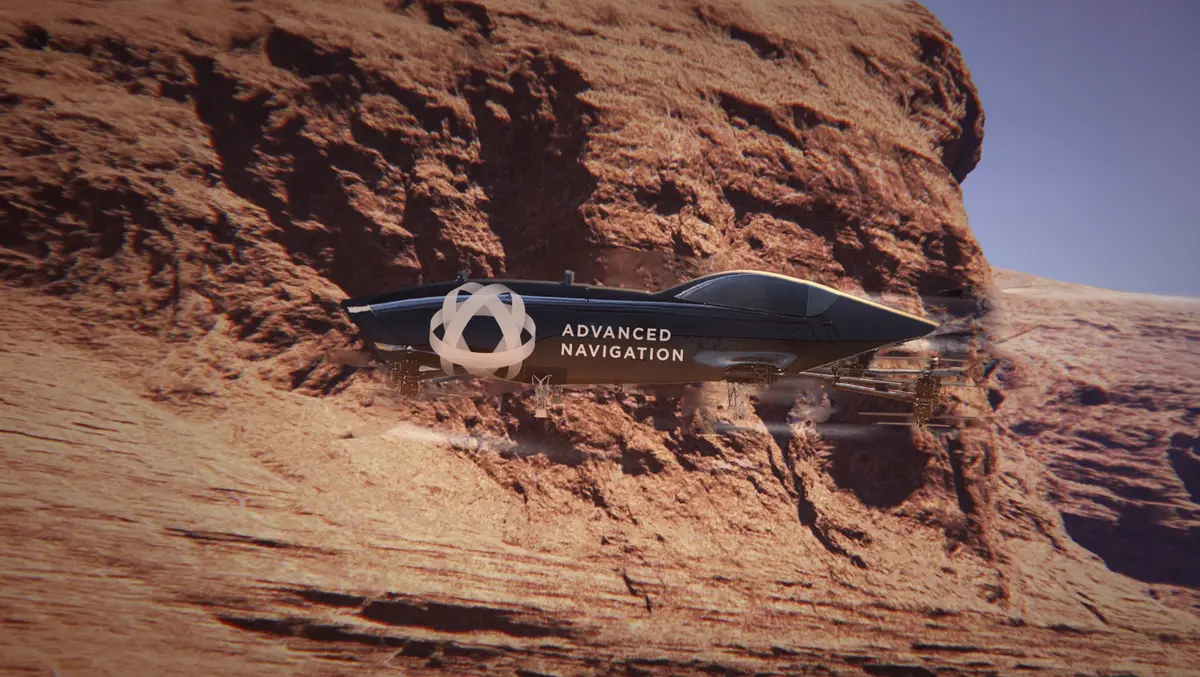

Advanced Navigation has been selected as the navigation partner for the Airspeeder International Series, an electric flying race car series set to debut in Adelaide.
Under the agreement, Advanced Navigation will supply sensors for the Airspeeder Mk3, a remotely piloted electric vertical take-off and landing aircraft designed to race at speeds above 120 km/h. The system will provide real-time data on position, velocity and orientation to support flight control during racing.
Airspeeder is staging head-to-head races between five pilots representing Australia, the United States, Great Britain, Italy and New Zealand. Pilots will operate the aircraft remotely using augmented reality, following a digitally mapped course over a physical motorsport circuit.
The format combines physical aircraft with a virtual track. Race operations include battery swaps in the pit lane and live feeds designed to show the race from the pilot's perspective. The series uses the Mk3, which has an eight-rotor design, a carbon fibre chassis, and a 96 kW electric powertrain.
For Advanced Navigation, the deal places its equipment in a new motorsport setting after deployments in defence, mining and other industrial applications. The programme will also allow engineers to test navigation performance in competitive flight conditions and refine sensor fusion systems.
Chris Shaw, Chief Executive Officer and Co-founder of Advanced Navigation, said the series presented a demanding technical environment for navigation systems.
"Motorsport has conquered land and sea. The next frontier is the sky. This is one of the most ambitious engineering challenges in modern motorsport, where every gram, every millisecond and every manoeuvre matters. We've spent years developing navigation technology for harsh and demanding environments. Now we're bringing that expertise to the next evolution of high-performance racing," Shaw said.
Race format
The Airspeeder Mk3 is intended for close-quarters racing, where aircraft make rapid directional changes and altitude adjustments while remaining on a synchronised virtual course. In that setting, accurate positioning data is central not only to flight stability but also to maintaining the integrity of the race format.
Advanced Navigation said its sensors would help the aircraft respond more quickly to dynamic manoeuvres and give race teams greater visibility into performance data. Pit crews and engineers can use that information during races to assess the aircraft's movement and race strategy.
Airspeeder said the same data could also shape the viewing experience through live three-dimensional tracking and analytics. The series presents itself as a hybrid of motorsport and esports, with pilots racing from remote cockpits rather than inside the aircraft.
Matt Pearson, Chief Executive Officer and Co-founder of Airspeeder, said navigation accuracy was critical as the series pushed the aircraft harder.
"Airspeeder exists to push advanced air mobility systems to their limits. At the speeds we're reaching, there is no margin for error," Pearson said. "That's where Advanced Navigation's technology gives us a real advantage. Proven in some of the world's most complex environments, their capability will extend our limits of speed, agility and control, setting new benchmarks for how the Mk3 is raced, how its performance is understood by our engineers, and how the sport will continue to evolve."
Beyond racing
Engineers plan to use data from the races to study how precise positioning can support flight control and collision avoidance in other aircraft, including drones, cargo eVTOLs, autonomous helicopters and tiltrotors, particularly in environments where GPS is unavailable or unreliable.
That gives the project a second role as a test environment for autonomous and uncrewed aviation systems. Competitive racing places aircraft under repeated high-stress conditions, providing a concentrated stream of performance data for navigation developers.