

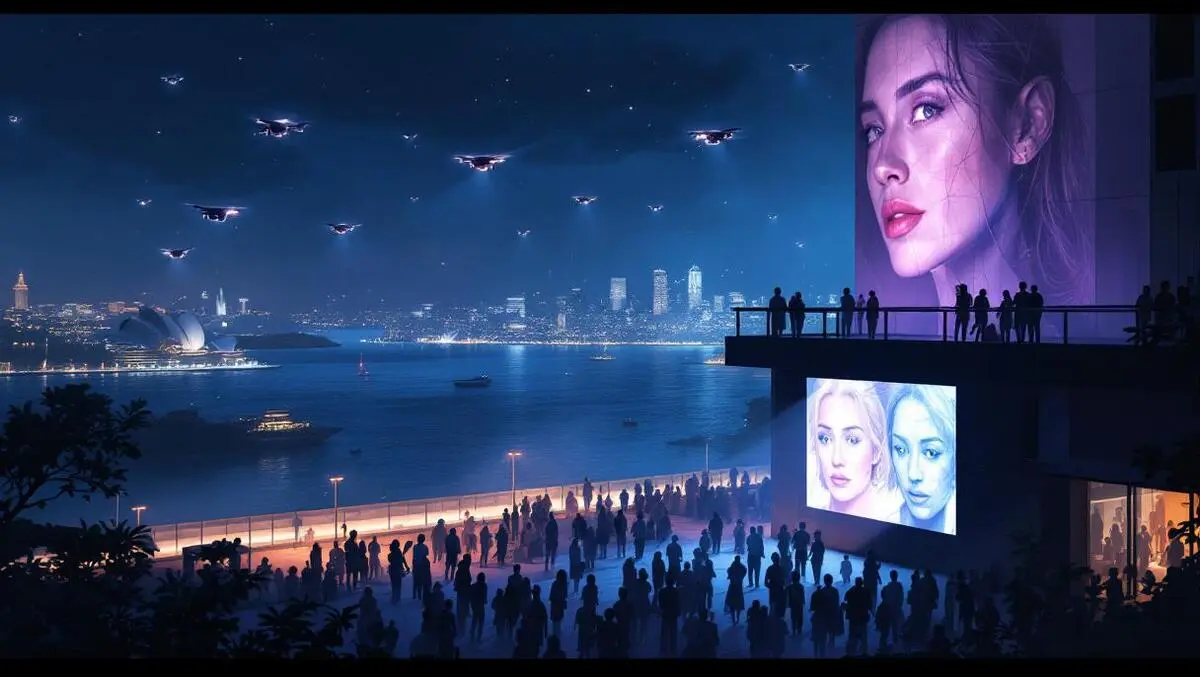

The Museum of Contemporary Art Australia has announced a three-part public programme examining machine vision and its influence on art, visual culture and everyday life. "Vision Machines" will run over three evenings at the museum in Sydney and is co-presented with The Power Institute.
The programme brings together academics, artists and musicians for talks, performances and screenings exploring how image-making technologies interpret and analyse what they capture. Topics range from surveillance and data extraction to the cultural politics of who gets seen.
Tickets cost $35 for adults, with discounts for MCA members, concession holders and students. Admission also includes entry to all current exhibitions at the museum.
Machine seeing
The series presents machine vision as a shift from recording images to processing them. Smartphones, CCTV, drones and medical imaging are among the tools increasingly used to classify, predict and trigger action based on visual inputs.
Across three sessions, the programme links these developments to contemporary art and creative practice, and places machine vision in wider social and political contexts, including warfare, policing and institutional power.
Nick Croggon, an art historian, writer and editor at The Power Institute, and Andrew Brooks, a lecturer in Media and Cultures at UNSW, will moderate all sessions. Brooks' research covers policing, abolition, technology, social movements and race.
Session one
The first event, "Operations", examines the systems and infrastructures behind machine seeing. It asks how machine vision shapes surveillance, warfare, data and art.
Speakers include Olga Boichak, Anna Munster, Michael Richardson, Joel Spring and Sian Troath. Troath is an associate lecturer at the University of Wollongong and researches the political economy of expertise, militarism, emerging weapons, and Australian defence and foreign policy.
Wiradjuri interdisciplinary artist Joel Spring will also take part. The programme notes that his work engages with "the desire for land and minerals at the core of our national identity".
The evening includes a screening of "Diggermode II: Cloud Ceding", described as exploring Australia's digital image economy.
Session two
The second event, "Models", turns to systems that analyse images and act on them-moving beyond capture and storage.
Participants include Machine Listening, Chris O'Neill and Elizabeth Stephens. Machine Listening is a research and art collective founded in 2020 by Sean Dockray, James Parker and Joel Stern, working across writing, performance, music, software, curation, pedagogy and radio.
The session culminates with T. Morimoto's "The Present is an End", billed as a live web-browser performance blending moving image, text and sound to sketch a speculative future.
Session three
The final event, "Ensembles", considers questions of neutrality and bias in machine vision, and how these systems shape who is seen-and who is not.
Participants include André Dao, Gary Foley and Thao Phan. Dao is a postdoctoral research fellow at Melbourne Law School and the author of Human Rights for the Data Society (CUP, 2026), which examines Big Tech and the United Nations.
Phan is a DECRA fellow and lecturer in sociology at the Australian National University. Her research focuses on gender and race in algorithmic culture, AI ethics, and data-driven racial classification.
Foley is a Gumbainggir educator at Victoria University and director of the Aboriginal History Archive. He is known for his leadership in demonstrations including the 1971 Springbok protests and the 1972 Tent Embassy.
The evening ends with a live performance, "Stable Confusion", by Worlds Only and Junior Major, described as colliding sound with AI-disrupting visuals.
Worlds Only is described as a seven-piece group focused on site-specific musical works and live improvisation. The programme highlights its emphasis on "the liminal space that happens with live improvisation".
Wider context
The series arrives as machine vision becomes more visible in daily life, from automated identification and behavioural detection to image sorting and content moderation. Cultural institutions have increasingly used public programmes to examine the social effects of artificial intelligence and the political choices embedded in technical systems.
At the MCA, the series is positioned as both an analysis of machine vision and a showcase of artistic responses, spanning panel discussions, screenings and live performances across the three evenings.
Join leading thinkers and artists at the MCA for a three-part series diving into how technology is reshaping the way we see the world.