

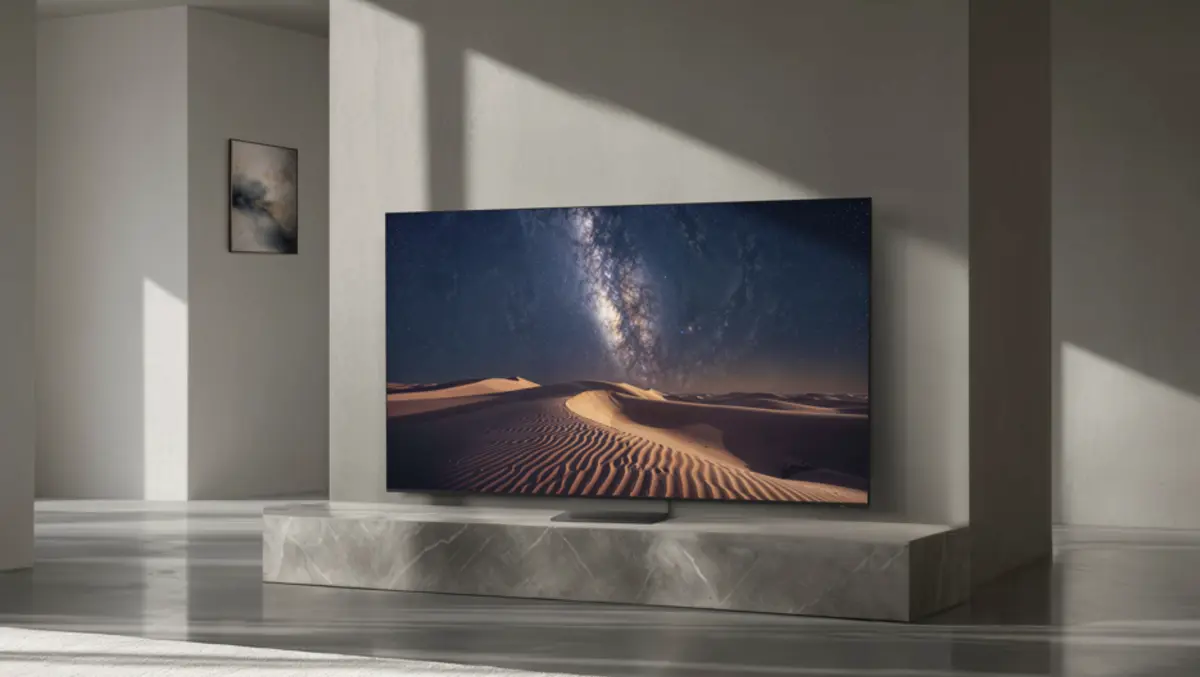
Footy finals drive surge in Samsung's giant TV sales
Tue, 13th Oct 2026 (Today).webp)
Samsung Australia says demand for larger televisions has risen ahead of the footy finals season, with internal sales data showing a 20% increase in TV sales before last year's AFL and NRL finals weekend.
Sales of screens measuring 75 inches and above rose 27% over the same period. Samsung's 98-inch-and-above category has also grown in value by more than 45% year on year, making it the company's fastest-growing TV size segment.
The figures highlight the role major sporting events play in consumer electronics spending in Australia, particularly among households upgrading living-room screens for shared viewing. Australia ranks fourth globally for the proportion of Samsung TV sales in the 75-inch-plus category and first in the Southern Hemisphere by that measure.
The shift has coincided with broader changes in pricing and product range. The average market selling price for a 98-inch TV is now about AUD $5,000, down from AUD $99,999 for Samsung's first 98-inch 8K TV introduced in 2019.
Samsung's current line-up includes eight models sized 98 inches and above across several ranges, up from four such models in 2025. Those products span screens from 98 inches to 115 inches.
At either end of the range are a 98-inch Crystal UHD model priced at AUD $3,799 and a 115-inch Micro RGB set priced at AUD $41,999. The spread suggests very large televisions are moving beyond a narrow premium niche, even as the biggest models remain expensive purchases.
Simon Howe, Director - Audio Visual, Samsung Australia, said buying patterns around the finals season are shifting towards larger formats.
"Samsung's 98 inch and above TV category has grown in value by over 45% year on year, making it our fastest-growing TV size segment and cementing the ultra-large screen as the new centrepiece of the Australian lounge room," Howe said.
He linked the trend directly to at-home sports viewing.
"Footy finals is now a catalyst for Australians to get that big TV they've been craving because it helps bring stadium-like immersion to our homes," Howe said.
Range and pricing
Wider availability has helped support the trend as manufacturers have expanded model ranges and lowered entry prices for very large displays. For retailers, the category offers a way to capture demand tied to seasonal events such as finals series, when household spending often shifts towards entertainment products.
Samsung argues today's market differs sharply from when 98-inch televisions first appeared at the top end of the sector. Falling prices have brought the category closer to higher-end mainstream buyers, though the market still spans a broad range, from relatively accessible models to sets priced far above the average.
"Today's ultra-large screen market is very different to 2019 when Samsung's first 98-inch 8K TV launched at $99,999," Howe said.
"Samsung offers a wide range of ultra-large TVs at various price points to ensure there is an option to suit every Australian lifestyle. From Glare-Free options, to Art TV options, every Samsung ultra-large screen is made for Australians, designed to deliver amazing picture and audio quality, a premium design, and Vision AI Companion smart features that consumers expect from the global number one TV brand for 20 years," Howe said.
Buyer concerns
Samsung also used the sales update to outline what it says consumers should consider when buying large-screen sets. These include image processing for bigger displays, reflection handling in bright rooms, and how a television looks when not in use.
On picture processing, Howe said buyers should pay attention to how lower-resolution content appears when enlarged across a much bigger screen.
"Detail can get lost when content is simply stretched across a larger screen. Ensure the TV you're looking at has big-screen specific technology like Samsung's Supersize Picture Enhancer. This feature uses AI to upscale content, focusing on noise reduction, tailored sharpness and black enhancement, helping to ensure picture quality is maintained at scale," Howe said.
He also pointed to glare as a practical issue in Australian homes, where open-plan living areas and bright daylight can affect screen visibility.
"Big screens can mean big reflections in bright Australian homes, and anti-reflection does not mean 'glare-free'. Samsung's Glare-Free coating is certified to help minimise on-screen distractions, so nobody misses the winning try or the final siren due to a stray reflection," Howe said.
For consumers concerned about the visual impact of large televisions in living spaces, some models are designed to double as display pieces when switched off.
"A big TV can mean a big black box when it's switched off. Samsung's ultra-large range includes the 98-inch The Frame TV which can transform into a work of art via Art Mode and The Art Store before and after the final whistle," Howe said.