

Hands-on review: Pocket AI Notetaker handy, not revolutionary
Thu, 7th May 2026
Pocket's AI Notetaker is a small recorder paired with a companion app to turn spoken conversations into structured notes. It works well for capturing phone calls if you can live with a few hardware quirks and an ongoing subscription. As far as in-person meeting transcription, the device is lacking.
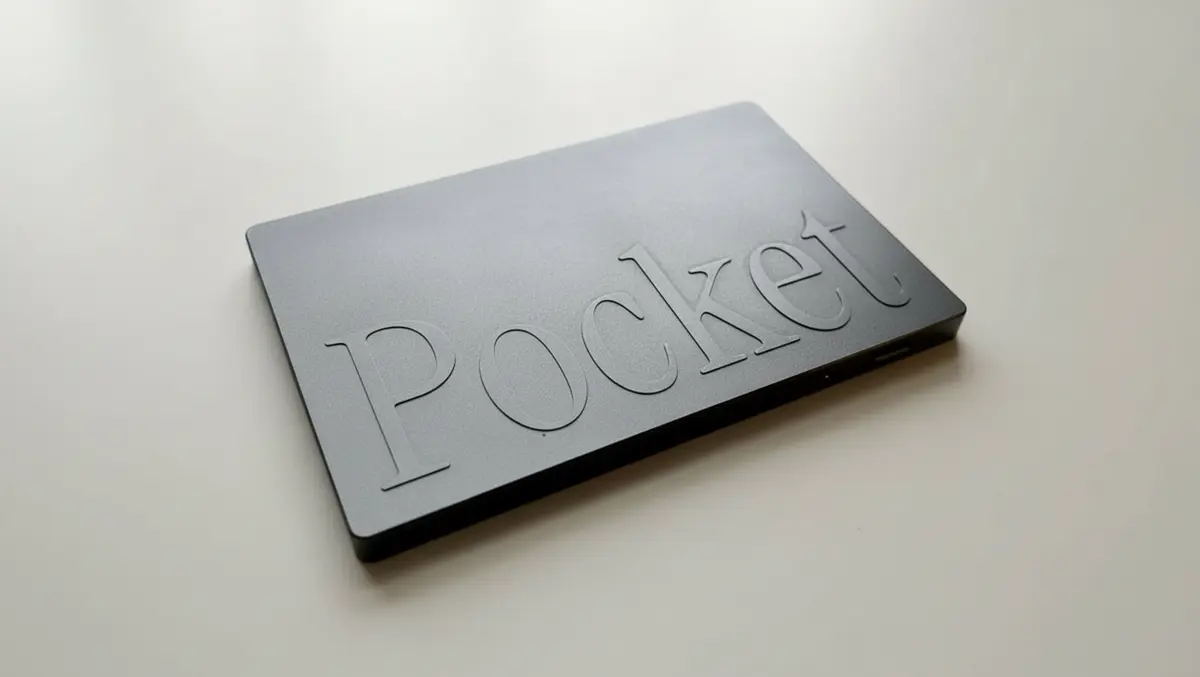
Pocket is roughly the size of a business card and features MagSafe. The casing feels solid, with a single multi-function button on the side. A small status LED sits near the top edge to show recording and pairing states. The design is understated and does not draw attention in a meeting room or café. There is no screen on the device, so you rely entirely on the LED and the mobile app for feedback.
Pocket uses a one-button control scheme. A short press starts or stops a recording, while a long press powers the unit on and off. A side switch changes the device from normal in-person conversation mode to call mode, switching from recording in-person conversations using its own microphones to capturing phone calls when attached near the handset's earpiece.
During testing, it was easy to double-tap by mistake, which can result in a series of very short clips instead of a single continuous recording. The LED glows during capture, but it is small and not very bright, making it hard to confirm the status at a glance in bright outdoor light. People who like robust physical controls may find this limiting.
The device pairs with an iOS or Android app over Bluetooth. Setup takes only a few minutes: install the app, create an account, and follow the prompts to pair Pocket and grant the necessary microphone and Bluetooth permissions. Once paired, the connection remained stable with a recent iPhone in testing. There is no local configuration menu on the device itself, so all settings live in the app.
Pocket's app is where the product becomes useful. The home screen lists recordings in reverse chronological order, with titles, timestamps, and durations. Tapping into a recording shows the full transcript alongside playback controls.
Pocket may suit people who spend much of their day in conversation and want an unobtrusive way to capture those conversations. People who already use phone-based transcription apps may see less benefit, but the dedicated hardware removes friction. I use Otter.ai for my day-to-day transcription, and I find the app works better- mainly because I can listen to the audio while reading the transcript.
The main selling point is Pocket's automated analysis. Each recording gets a short written summary, followed by a set of bullet points highlighting key topics or decisions. There is also a dedicated section for action items that identifies tasks and assigns suggested owners when names are clearly stated. In practice, the summaries are concise and generally reflect the tone of the meeting. The model is good at capturing decisions and follow-ups, especially in structured discussions with clear turn-taking. It is less reliable in chaotic group conversations, where people talk over one another. In those cases, the summary can miss nuance or attribute a point to the wrong speaker, so you still need to skim the transcript. While there is no way to click on a word in the transcript and match the audio, Pocket splits the audio by speaker turn, usually into bite-sized recordings.
Transcription accuracy is strong in quiet conditions. Clear, mid-range voices in a small room are usually rendered with only minor errors. Proper nouns and company-specific jargon are more hit and miss, but the meaning is rarely lost. The call recording performance is similar: domestic calls over a mobile network were transcribed accurately at reasonable volume levels.
Beyond basic transcripts, the app offers tools to organise and revisit material. You can assign recordings to projects, add manual tags, or pin important sessions to the top of the list. There are options to generate mind maps that show topics and subtopics from a meeting, which can be helpful when planning follow-up work. The app can also create calendar events from action items and email a summary to participants if you want to share notes. Export options include plain text and, in some cases, formatted summaries that drop into a document or note-taking app with minimal cleanup. These options make Pocket more useful to project managers and knowledge workers who need to track many conversations.
In testing, the device comfortably handled a few hours of recording spread each day for several days without needing a charge. Charging is via USB-C on the side, and a full charge takes less than a couple of hours from empty. There is no wireless charging or battery level indicator on the device, so you rely on the app to see the remaining charge. That is acceptable in regular use but less convenient if you forget to check before leaving the house.
Pocket stores and processes recordings in the cloud, with encryption in transit and at rest. You can delete individual recordings or wipe your entire history from within the app. There are also options to disable cloud retention after processing, although this removes the ability to revisit full transcripts.
The hardware is a one-off purchase, but most of the value sits behind a subscription. Unlimited or high-volume transcription and advanced AI features require a monthly or annual plan. There is a free tier with unlimited minutes but basic functionality. Upgraded options provide higher accuracy and unlimited summaries as part of the offering. Premium pricing is roughly in line with other AI note-taking services (CAD $24.99 a month or CAD $249 a year), but buyers should factor in the ongoing cost when making their decision. For occasional users, a purely app-based recorder may be more economical. Please note TechDay did not test the premium offering for this review.
You can start recording without unlocking your handset or opening an app, which makes spontaneous interactions easier to capture. Those who dislike carrying extra gadgets, or who need deep integration with existing enterprise tools, may not find enough here to justify the cost.