

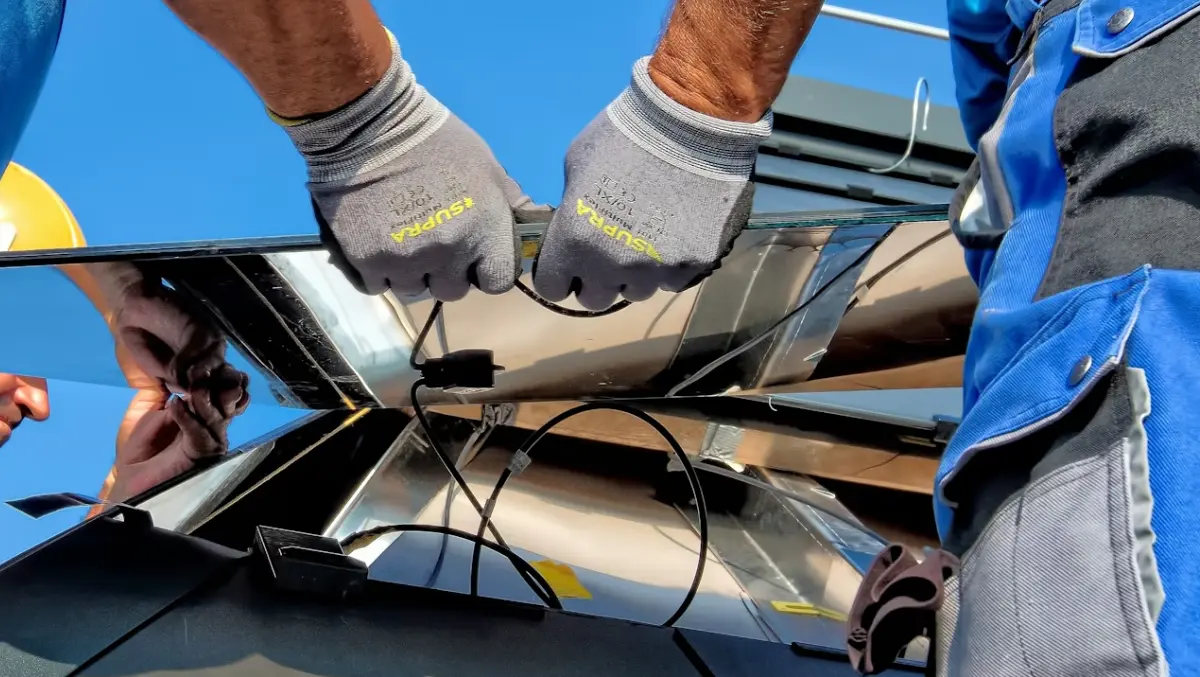
The hidden problem with Australia's ageing solar fleet - and the tech fixing it
Tue, 5th May 2026
Australia fell in love with rooftop solar early. Driven by generous government rebates, falling panel prices, and rising electricity bills, the country embarked on one of the most rapid residential solar rollouts the world had seen. By the early 2010s, rooftops across South Australia, Queensland, and New South Wales were being covered at a pace that installers struggled to keep up with. It was, by most measures, a genuine consumer technology success story.
But technology ages. And fifteen years on, that early boom has created a problem that the industry is only beginning to reckon with at scale: millions of residential solar systems that are quietly underperforming, failing, or approaching the end of their useful life - often without the homeowner having any idea.
For households in South Australia, where the solar rollout was among the most aggressive anywhere in the country, the issue is particularly acute. Many of the systems installed between 2009 and 2013 are now operating with degraded panels, failing or failed inverters, and monitoring systems so outdated they can't communicate with modern diagnostic tools. Homeowners who bought a solar and battery package Adelaide installers were promoting heavily in that era are in many cases running on hardware that is a fraction as effective as it was at installation - and receiving electricity bills that quietly reflect that reality without knowing why.
The good news is that the diagnostics technology being used to assess, triage, and repair these ageing systems has advanced considerably. The bad news is that most homeowners don't know to ask for it.
What's Actually Going Wrong
Solar panels are rated to produce a certain percentage of their original output over time - typically 80% after 25 years, degrading at around 0.5% per year under normal conditions. That's the optimistic version. Real-world degradation varies considerably based on panel quality, local climate conditions, soiling, and whether the system has ever been professionally serviced.
South Australian conditions are particularly demanding. Intense summer heat, dust from dry periods, and UV exposure levels that exceed the testing conditions used for European panel ratings all accelerate degradation beyond the nameplate warranty assumptions. Systems installed with lower-grade panels - and during the early boom, margin pressure meant that not every installation used quality hardware - may be degrading at twice the rated rate or more.
But panel degradation, while real, is often not the primary failure point. Inverters are. The inverter is the most mechanically and electronically complex component in a residential solar system - it converts DC power from the panels into AC power the home can use, manages grid interaction, and in modern systems handles battery charging and monitoring. Inverter lifespans typically run 10 to 15 years. For systems installed in 2010, that clock has run out.
A failed or failing inverter can present in several ways: complete system shutdown, intermittent generation drops, error codes on the display, or - most insidiously - continued partial operation that generates some power but well below the system's rated capacity. That last scenario is the hardest for homeowners to detect without active monitoring, because the system appears to be working.
The Diagnostics Technology Closing the Gap
The gap between what a solar system is producing and what it should be producing has historically been very difficult for homeowners to quantify. Early-generation monitoring systems, where they existed at all, typically displayed only basic generation totals - not the granular performance data needed to identify specific panel or inverter faults.
Modern diagnostics have changed this significantly. String-level and module-level monitoring - now standard on better inverter platforms - allows technicians to isolate performance at the level of individual panels or panel groups. A panel operating at 60% of its rated output, shaded by a neighbour's new addition or degraded by micro-cracking invisible to the naked eye, shows up clearly in a string-level performance report in a way it simply wouldn't have a decade ago.
Thermal imaging has become an important diagnostic tool for panel-level assessment. Infrared cameras - now available as drone-mounted systems that can survey an entire rooftop in minutes - identify hotspots caused by cell damage, bypass diode failure, or soiling patterns. A hotspot that would require individual panel testing to find by conventional methods shows up as a clear thermal anomaly from the air. For large commercial systems, drone thermal surveys have become essentially standard practice. They're increasingly being applied to residential assessments as well.
IV curve tracing - measuring the current-voltage relationship across a panel or string - gives technicians a detailed picture of how a panel's electrical characteristics have shifted from its original specifications. A panel whose IV curve has degraded significantly from its datasheet values is a panel that needs replacement, regardless of how it looks visually.
The Inverter Replacement Cycle
The volume of inverter replacements being processed across Australia's solar service sector has risen sharply over the past two to three years, and the curve is still climbing. Simple maths explains why: the systems installed during the 2010–2014 boom are hitting their inverter end-of-life window right now, all at once.
What makes inverter replacement more technically interesting than it might appear is the compatibility question. The grid rules and standards that govern how inverters interact with the South Australian network have changed considerably since those original installations. A replacement inverter must comply with current AS/NZS 4777 standards for grid-connected inverter energy systems - standards that have been updated multiple times since many of the original units were certified.
This means a straightforward inverter swap isn't always straightforward. The replacement unit may have different export limit settings, different anti-islanding behaviour, and different communication protocols for interacting with SA Power Networks' demand management systems. Getting this right requires an accredited installer who understands not just the hardware but the current regulatory environment - which is itself a more complex landscape than it was when the original systems went in.
The Opportunity Hidden in the Problem
There's a meaningful opportunity embedded in Australia's ageing solar fleet problem, and it sits at the intersection of hardware upgrade cycles and the rapidly falling cost of battery storage.
A homeowner with a 10-year-old 5kW system facing inverter replacement is in many cases better served by a full system assessment than a like-for-like swap. Modern hybrid inverters - which manage both solar generation and battery storage in a single unit - have fallen dramatically in price. The federal government's battery incentive scheme currently running in South Australia offers subsidies that can offset a significant portion of a battery storage addition. The calculus for adding storage at the point of inverter replacement is considerably better than it was even two years ago.
The solar systems installed during Australia's first great renewable boom did their job. They got solar onto millions of rooftops, created a generation of energy-literate homeowners, and laid the foundation for the more sophisticated home energy infrastructure being deployed today. Now they need to be assessed, repaired, upgraded, or replaced - with technology that didn't exist when they were first installed.
That's not a failure of the technology. It's just the normal lifecycle of consumer hardware, playing out on a national scale.