

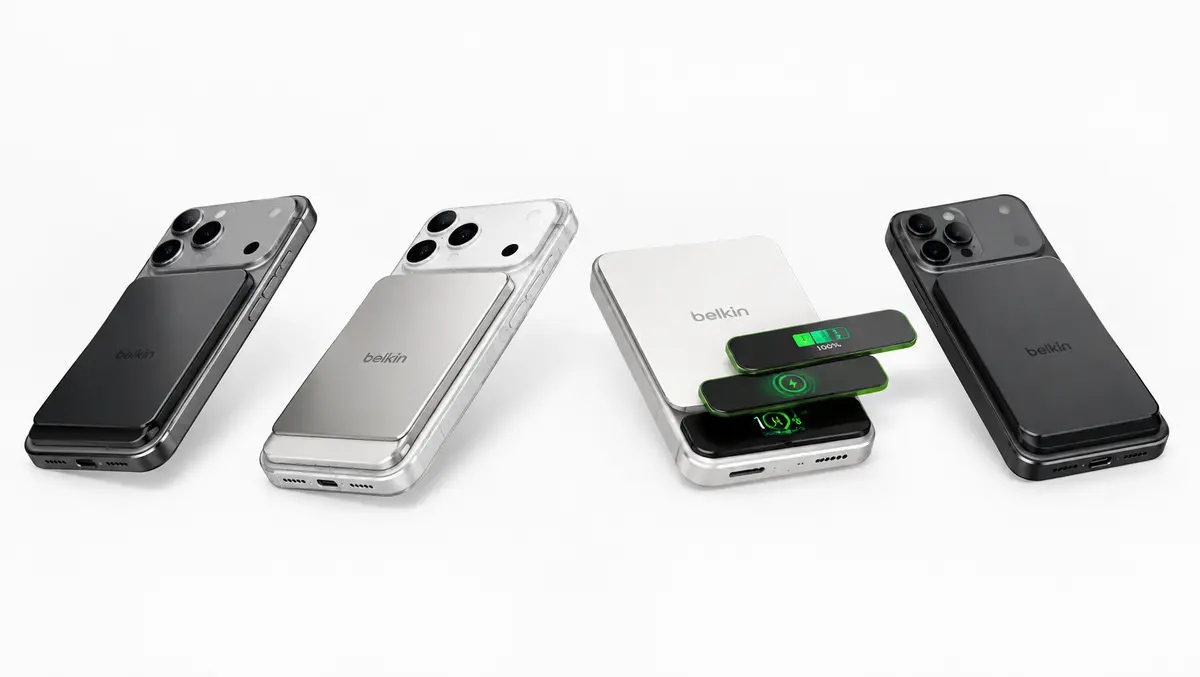
Belkin unveils semi-solid-state power banks for Australia
Mon, 14th Sep 2026.webp)
Belkin has unveiled a new UltraCharge Pro range of power banks using semi-solid-state battery technology, with two models due to reach the Australian market in January 2027.
The products are among the company's first to use what it calls BoostSolid Cell technology, a battery design that adds a gel-like layer alongside a liquid electrolyte. Belkin says this allows for thinner devices and a longer operating life than conventional liquid-cell power banks.
The launch comes as accessory makers look for new ways to stand out in a market where battery size, form factor and safety are becoming more important selling points. Belkin says the new architecture is designed to last up to three times longer than other power banks and retain up to 80% of capacity after 1,000 charge cycles.
Safety is central to the pitch. Belkin says the battery design is intended to reduce the risk of thermal runaway, fire and swelling, while supporting stable charging in operating temperatures between 0C and 40C.
The devices use dual analogue and digital temperature sensors to monitor the battery every 250 milliseconds and cut power automatically if limits are exceeded. The range has also been tested for nail puncture resistance, high-temperature exposure, extreme cold performance, drops, impacts and vibration.
Two models
The first is the UltraCharge Pro Slim Magnetic Power Bank 5K Qi2 15W with BoostSolid Cell. It has a 5,000mAh battery, measures 8.8mm thick and is 40% slimmer than Belkin's other 5K power banks.
The model uses Qi2 magnetic wireless charging at up to 15W and includes a USB-C port that supports wired charging at up to 20W under the PD protocol or 22.5W under the SFC protocol. It also supports pass-through charging at 7.5W wireless and comes with a braided USB-C to USB-C cable.
In Australia, the 5K model will be priced at AUD $119.95 and offered in black and sand.
The second device is the UltraCharge Pro 10K 60W with BoostSolid Cell and Display, aimed at users who want to charge not only phones and tablets but also laptops and other USB-C devices while away from mains power.
It has a 10,000mAh battery and supports USB-C Power Delivery of up to 60W through a single port, with up to 30W shared output. The device also includes a USB-A port with output of up to 22.5W and a 40W USB-C input for recharging the power bank itself.
A built-in display shows battery level, charging status and thermal information. Belkin says the 10K model is 27% smaller than a standard 45W power bank with similar capacity.
The 10K unit will sell in Australia for AUD $149.95 and will also come in black and sand.
Design and standards
Both products use a metal body with a soft-touch finish and will be shipped in 100% plastic-free packaging.
The power banks are designed to meet UL2056-2015 safety standard requirements and TSA standards. That matters in a category where concerns over overheating and transport rules have become more visible as consumers carry larger battery packs during daily travel and on flights.
Belkin sells accessories in more than 100 countries and has been in the consumer electronics market for more than 40 years. Portable charging products remain a core part of its business, alongside connectivity, audio and device protection accessories.
The move into semi-solid-state batteries reflects a wider industry effort to improve energy density, product lifespan and safety without making portable chargers larger. Manufacturers have been under pressure to balance faster charging with heat management and airline compliance as consumers use more power-hungry phones, tablets and laptops.
For buyers, the commercial test will be whether thinner designs and longer cycle life justify higher prices in a crowded market. For Belkin, the launch provides an early position in bringing semi-solid-state battery designs into mainstream consumer accessories rather than keeping them confined to specialist or industrial products.
The Australian release is scheduled for January 2027 through Amazon and selected retailers, with both models positioned at the upper end of the portable charger market.