

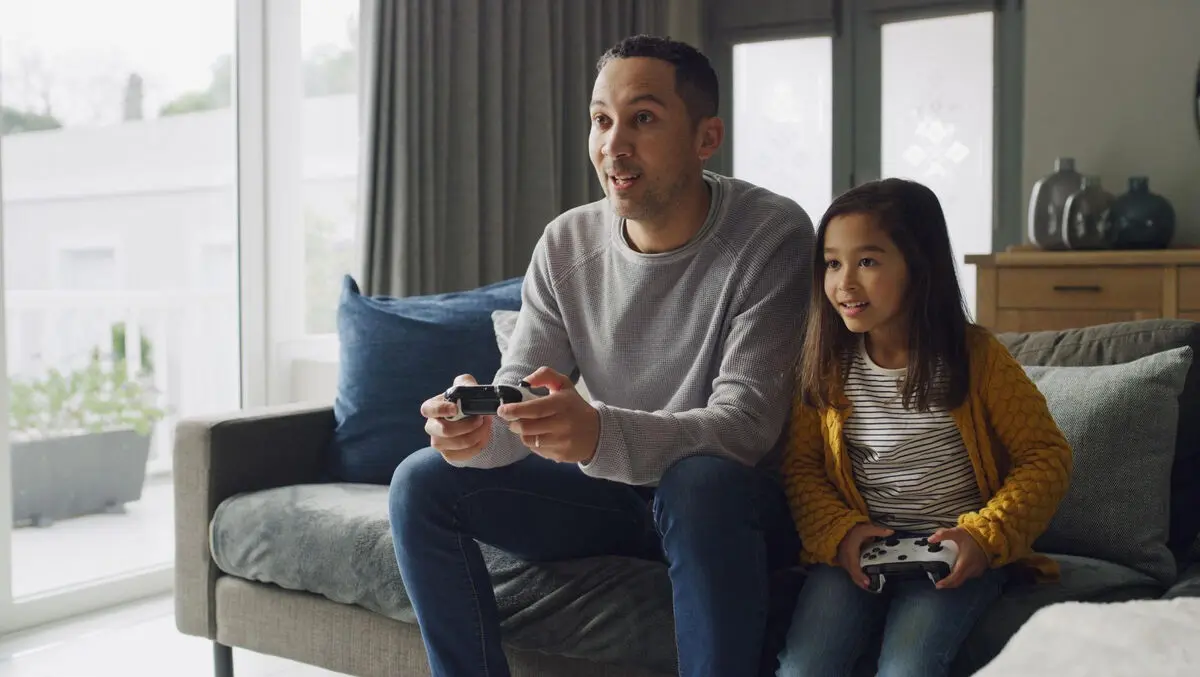
More Australian parents are gaming with their children
Thu, 5th Nov 2026 (Today)
Logitech G has released research showing more than half of Australian parents play video games with their children, and that children tend to enjoy those sessions more than their parents do.
The findings are based on a survey of 822 Australian parents aged 18 to 45. Parents who said they game with their children spend an average of 2.5 hours a week at a console or keyboard.
Among those surveyed, 51% said their children "really enjoy" playing alongside their mother or father, while 85% said their children enjoy it at least somewhat.
Parents were slightly less enthusiastic. The research found 79% at least somewhat enjoy gaming with their children, while 40% said they "really enjoy" it.
The figures suggest gaming is becoming a regular part of family leisure time in Australia, rather than a separate activity for children. Logitech G said this reflects a broader shift in how parents use digital entertainment as part of time spent together at home.
The trend also sits within a broader backdrop of gaming in Australia. Logitech G cited an audience of more than 17 million Australians who play video games, underlining how far the medium has entered the mainstream.
Family time
The survey also suggested a link between gaming frequency and time spent together more generally. Parents who game with their children at least once a week typically report more overall hours of quality time together.
The research does not establish whether gaming itself increases family time, or whether families who already spend more time together are more likely to play games. Even so, the results add to evidence that households increasingly treat video games as a shared activity rather than a solitary one.
That matters for games hardware brands and publishers because family play broadens the market beyond the traditional image of the teenage or young adult player. It also gives companies such as Logitech G grounds to argue that gaming accessories are tied not only to competition or performance, but also to domestic entertainment habits.
Dan Hall, Senior Category Manager at Logitech G ANZ, said parents do not need to be highly skilled players for the activity to matter to children.
"Most parents know the feeling of being handed a controller and being told to keep up," Hall said.
"It might not be a game they've played before, or they could be dusting off the cobwebs from gaming sessions and console generations long past, but it doesn't really matter.
"What matters is that kids will remember their mum and dad sat down and put in the effort. That's what's key here - parents might not be able to match their children's passion for the latest games, but they're still meeting them where they are. Kids are clearly getting something from their parents joining the fun, and gaming is the conduit that brings the generations together."
Changing habits
The results also reflect the age profile of today's parents. Many adults in the 18 to 45 bracket grew up when consoles, handheld devices and PC gaming became common in Australian households, making them more familiar with games than earlier generations of parents.
That familiarity may help explain why video games now sit alongside more established family activities. Rather than replacing offline interaction entirely, the survey suggests gaming can provide another setting for parents and children to spend time together, particularly when schedules limit opportunities for longer activities outside the home.
For the games industry, that raises commercial and cultural questions about how titles are designed and marketed for shared household use. If more parents are participating, developers and accessory makers may see continued demand for products aimed at cooperative, casual or cross-generational play.
At the same time, the gap between children's and parents' enjoyment levels points to a limit. Children may see games as a natural part of play, while adults may approach them more as a tool for connection than as a pastime in its own right.
Hall said that difference does not reduce the value of the experience.
"Today's parents grew up as gamers, and this familiarity with consoles and computers is providing another place to interact," Hall said.
"Chasing a high score or defeating a boss together is as much a bonding experience as kicking a football around or reading a bedtime story.
"Gaming can often be seen as replacing in-person connection, but as this research shows, it's actually supplementing it. It allows the family to connect more frequently than they otherwise would, and for that, gaming should be celebrated."