

Game review: Dragon Quest I & II HD-2D Remake (Xbox Series X)
Tue, 11th Nov 2025
Square Enix has been remastering and remaking a ton of its back catalogue in recent years. We've seen Final Fantasy VII Remake and Final Fantasy VII Rebirth, plus Dragon Quest III HD-2D Remake came out last year.
The re-releases keep on coming because Tales of Xillia Remastered just came out, and now we have Dragon Quest I & II HD-2D Remake. The first two Dragon Quest games were released back in the '80s for the original NES console. Due to this, Square Enix decided to remake both games to introduce them to a newer audience.
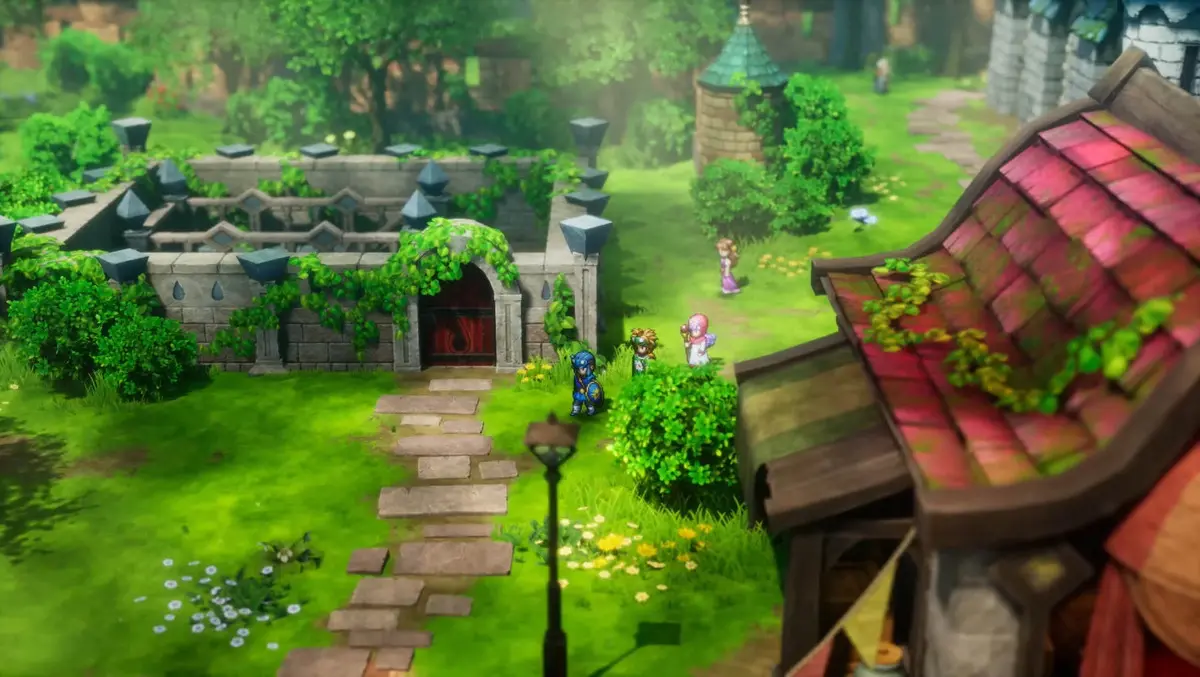
The first thing I want to comment about Dragon Quest I & II HD-2D Remake is that the new graphics look gorgeous. The character models still retain the original 2D pixel art appearance, but the environments are now rendered in full 3D.
While playing on Xbox Series X, the game runs at a smooth 60fps on both Quality and Performance modes. The only version that cannot run the game at 60fps is if you are playing the game on the original Switch console. The first Switch can only run the game at 30fps.
Not to mention, Dragon Quest I & II HD-2D Remake feels like a bargain because you are getting two quality video games for the price of one. Dragon Quest III HD-2D Remake is the same price, but you only get one game.
Anyway, Dragon Quest I is the first game in the series, and you assume the role of a hero who is a descendant of the legendary Erdrick. Erdrick brought peace to the land of Alefgard several centuries ago, and the area is now protected by a special Ball of Light.
However, an evil being named the Dragonlord has stolen the Ball of Light. Due to this, Alefgard is unprotected and is now overrun by evil monsters. As the hero of the story, you are tasked to recover the Ball of Light, rescue Princess Gwaelin, and defeat the Dragonload once and for all.
Dragon Quest II, on the other hand, has a slightly different story. The game takes place 100 years after the first one, and its introduction is quite sad and violent. This is because an evil sorcerer named Hargon leads a devastating attack on Moonbrooke Castle and its citizens.
You now assume the role of the Prince of Midenhall, and he is tasked to find his two cousins, who are also descendants of the hero named Erdrick. The trio now has to defeat Hargon and the Demon Lord called Malroth.
Since both Dragon Quest I and Dragon Quest II were originally released in the late '80s, both games still have the old-school turn-based combat system. For players who are unaware, turn-based combat means you have to take turns while attacking enemies.
For example, if I choose to do a physical attack on an enemy, I have to wait my turn before I can attack again. This gives the chance for an enemy to attack you, and you have to make sure your party is healthy enough to finish each battle.
Unfortunately, both Dragon Quest games don't adopt the dodge or counterattack manoeuvres that are featured in a new game like Clair Obscur: Expedition 33. Instead, you just have to sit there and get hit all the time whenever it's not your turn to fight.
Another thing I did not like about the combat in both games is that random battles are frequent. Unlike more recent RPGs, you cannot avoid or pick enemies that you want to fight. Even an RPG like Bravely Default allowed you to increase or decrease the frequency of random battles.
Lastly, the visual presentation of the battles in both games is disappointing, too. This is because all battles are fought from a first-person perspective, but you cannot see your character attacking the enemies. Instead, all that you see is just a slash that appears on enemies when you hit them.
Despite the battles being very old-school, Square Enix has added some helpful quality-of-life features to make both games much easier for new players. For one thing, both games have an easy mode that grants all characters invincibility during battles.
Square Enix also made navigation much easier for newer gamers, too. The development team has added a quest marker on the map highlighting where you need to go to next. Not only that, but you can also use an option to expose where hidden chests are in the game as well.
The other helpful new feature is a fast-forward mode. You can skip dialogue scenes, and also make battles move faster too. I found the default battle speed to be too slow, so I sped the game up to its maximum setting in order to grind through random battles at a much faster rate.
Another nice new feature in both games is that voice acting has been added for the very first time. Voice acting isn't included in every dialogue scene, but it adds more life to important cutscenes in the game.
The only thing that might disappoint some people is that the game requires you to grind for several hours in order to be strong enough against some bosses. This, in turn, makes the game feel very repetitive because random battling lots of enemies for hours on end can get tiring.
Despite having some annoying game mechanics, Dragon Quest I & II HD-2D Remake is an excellent remake. The graphics and presentation are gorgeous, plus this is the best way to experience these RPG classics. Old school RPG fans are sure to enjoy this package.