

Samsung aiming for record-breaking 2026 with upcoming range
Wed, 20th May 2026
Always at the cutting edge of television technology, Samsung is aiming to make a splash with its new range of OLED and Micro RGB screens, due for release later in 2026.
AI integration is a significant aspect of interesting new features consumers can expect in the latest Samsung range, including a new mode tailored to football fans, improved personalised recommendations based on viewing history, as well as enhancements to upscaling and motion processing.
While the viewing experience for beaming live sport into lounge rooms has never been better, with increasingly high definition cameras and microphones picking up every second of the action, Samsung is focused on enhancing the experience to make it feel like fans are really there in person.
Responding to customer feedback, the new AI soccer mode allows you to boost the output of crowd microphones, bringing the raw atmosphere of the fans through the TV, while also providing control over the volume of the commentator's audio.
This allows viewers to lower or even mute the commentary audio if they are detracting from the viewing experiene, leaving only the sounds of the players and crowd, to mimic that authentic in-stadium experience despite being potentially thousands of kilometres away.
"I've been focusing on AI recently. So, AI features are the most important things," said Andrew Sohn, Senior Engineer at Samsung Electronics.
"Basically, including the AI Soccer Mode, and Vision AI Companion. And all these settings are based on AI models. Like upscaling, motion. Everything is based on AI.
"So, it's better to focus on the AI features. We received lots of feedback, and we think that it's a very good function for every consumer. It's not specifically for the FIFA World Cup. But it's good timing."
For prospective purchasers looking for a screen that excels in peak brightness, durability and performance in bright rooms, Micro RGB is definitely an option worth considering.
Beating out OLED technology to achieve intense colours and deeper blacks, Micro RGB utilises microscopic red, green and blue light sources to produce pure colours without passing through colour filters.
Samsung's Micro RGB screens are ideal for buyers whose living room or bedroom receives plenty of natural light, with its specialised anti-glare coating, and also boast excellent energy efficiency, according to Kevin Cha, Principal Engineer - Video/Image Processing at Samsung.
"The difference between Micro RGB and Mini RGB is a combination of hardware and software," Cha said.
"Physically, the size of each LED is under 100 micrometres. So I think that's going to be very helpful for expressing the colour. We have Samsung AI engines, to control the micro-sized RGB accurately. That's a very hard technology to control those micro-sized RGBs.
"I think that in the era of the micro-RGB, the important thing is how we handle the light, each RGB light. So we're using the AI engine based on the input video, to control each RGB light."
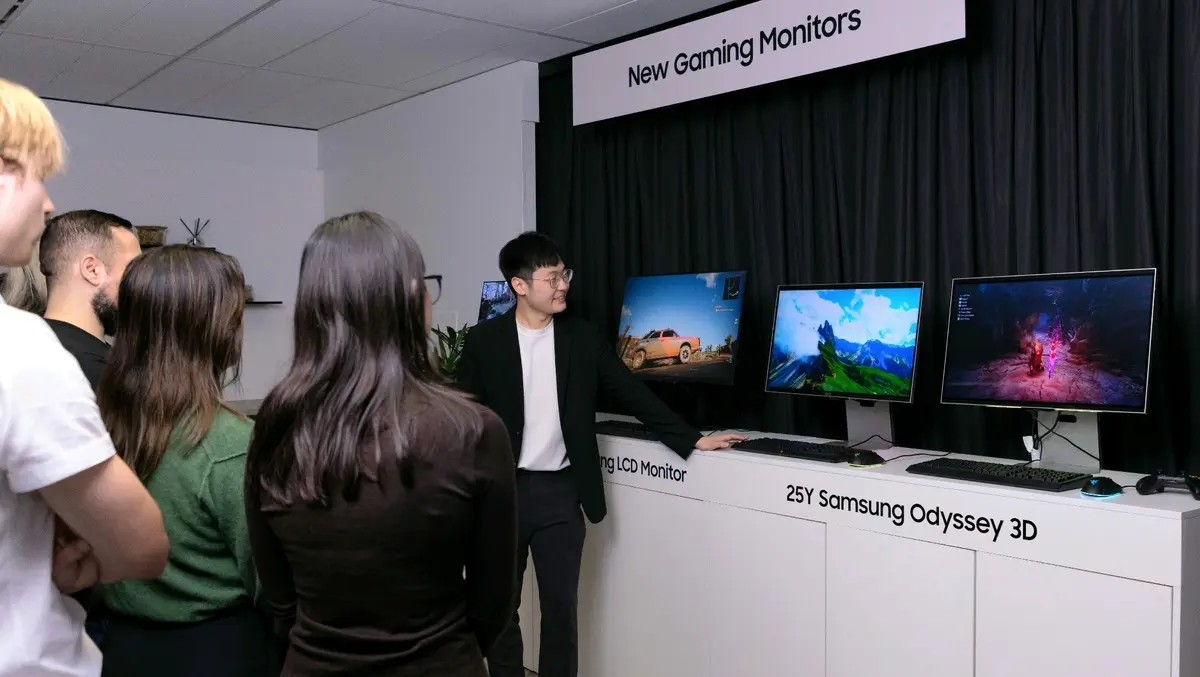
Turning its attention to gaming, close to one in two monitors sold in Australia are now gaming monitors, and Samsung is looking to break records and increase its share of the rapidly growing monitor market with its new Odyssey range.
New features include faster refresh rates, new screen sizes and 3D visuals. While the current availability of games capable of utilising 3D technology may still be limited, Samsung sees this as an area of growth.
Small cameras embedded in the top of the screen use advanced eye tracking technology and a lenticular lens, with users also required to use Samsung's Reality Hub app.
With products across the range catering to everyone from professionals looking to upgrade their work-from-home set-up, to gaming diehards, there is something for every buyer, according to Maxime Dupont, Head of Product at Samsung.
"The beauty of Odyssey as a range is the fact that we cater for every gamer, from the most casual to the professional gamers," Dupont said.
"In the entry-level space, we've got some great 24, 27-inch gaming monitors, 144 hertz, 1 millisecond. Then the top end, from a refresh rate perspective, we go all the way up to 120 hertz. In terms of screen sizes, on the lower end, we're at 24-inch. The largest one is a 57-inch, which I don't believe there's anything bigger right now in the market.
"In terms of innovation for this year (the new 3D technology) is pretty phenomenal. I think it's a great step in the right direction. As well, we're now moving into 6K. Then we continue to expand our OLED range.
"We've been a leader in OLED gaming pretty much from the get-go. And it's great to see we now have options from 27-inch all the way to 49-inch."