

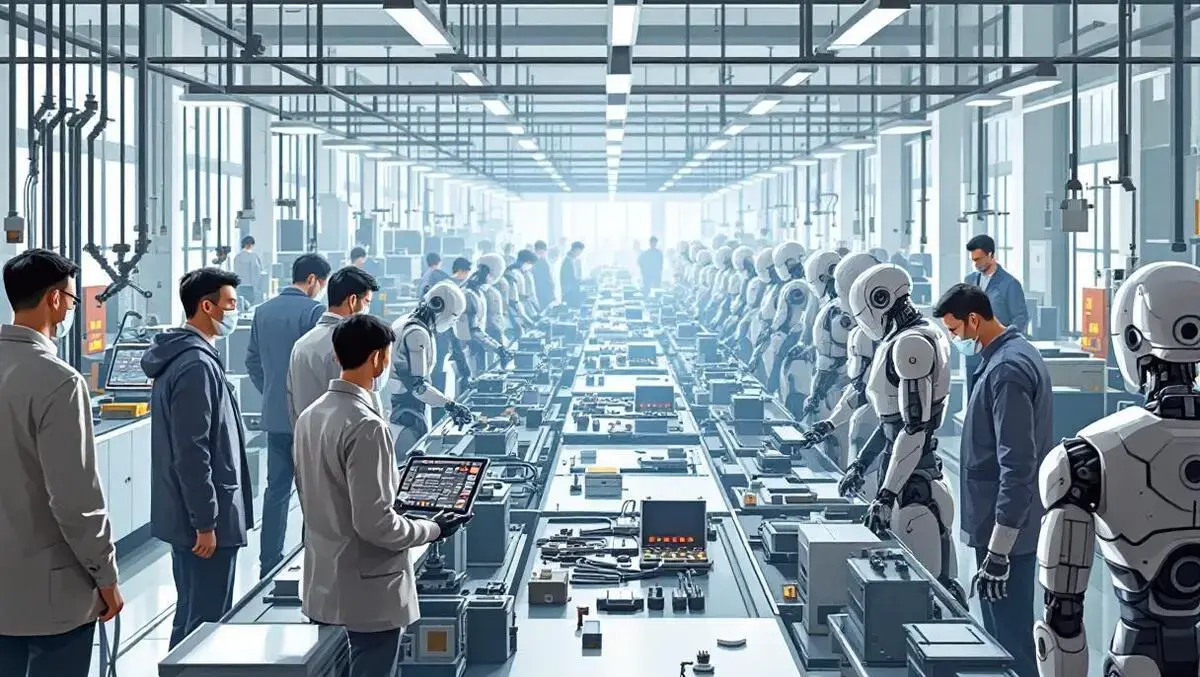

Chinese vendors led the global humanoid robot market in 2025, with worldwide shipments approaching 18,000 units, according to IDC.
Total revenue reached about USD $440 million, while cumulative orders were estimated to have exceeded 35,000 units, suggesting a broader pipeline beyond units already delivered.
IDC said the market reached the starting point of large-scale deployment last year, with shipments rising about 508% from the previous year. The figures indicate a sharp increase in commercial activity for machines designed in a human-like or semi-human form, typically with a torso, head and two arms.
Chinese lead
Chinese manufacturers accounted for the largest share of commercial deliveries, supported by domestic supply chains, faster product iteration and lower costs. That gave them an early advantage as humanoid robots moved from development and pilot work into broader deployment.
Zhiyuan Robotics and Unitree Robotics each shipped about 5,000 units, putting them at the top of the market by volume. Both showed an ability to deliver at scale across a range of uses.
Leju Robotics, Accelerated Evolution and Songyan Dynamics shipped around 1,000 units each, with deployments concentrated in specific use cases. Galaxy General, UBTECH, Zhongqing Robotics and Stardust Intelligence shipped between 400 and 1,000 units, mainly through pilot projects and customised deliveries.
Another group of companies remained at an earlier commercial stage. Xingdong Era, Magic Atom, Beijing Humanoid Robot Innovation Centre, Xinghaitu, Mojia Zhichuang and Zhuji Power each shipped more than 100 units.
Outside China, shipments remained much lower. Apptronik, Figure AI and Agility Robotics were still largely in pilot testing, with shipments in the tens of units, according to the data. Tesla's humanoid robot remained in internal testing.
Product split
Biped robots were the main product type by revenue in 2025. Full-size and small-to-medium biped models together accounted for 66.3% of total market revenue.
Within that category, full-size biped humanoid robots generated 41.6% of total revenue, the largest share of any segment. IDC linked that position to use in guided services, retail assistance, entertainment performances, and research and education.
Small and medium biped models occupied a different part of the market. Their lighter designs and lower prices made them more common in entertainment, education and research, where lower load capacity and narrower task requirements are acceptable.
Wheeled humanoid robots followed a different path. These products drew demand from data collection, industrial manufacturing and warehouse logistics, where mobility and cost matter more than a fully biped form.
Use cases
Early commercial demand was concentrated in entertainment, education and research, and data collection. IDC said these settings were well suited to demonstration, interaction and technical validation, making them the first areas where commercial deployment has taken shape.
The market is also beginning to change in how suppliers sell their products. Alongside one-off hardware sales, companies are moving towards Robot-as-a-Service, maintenance services and platform-based models, creating recurring revenue streams as well as direct equipment sales.
That shift suggests suppliers are trying to build longer commercial relationships with buyers as the technology matures. It also reflects the practical demands of operating humanoid robots in the field, where maintenance, software updates and integration work can be as important as the machines themselves.
Technical focus
The sector is moving from laboratory testing to engineering work and larger deployments. Its next stage will depend on how manufacturers integrate the robot body, motion control systems and cognitive decision-making software into products that can operate reliably in changing environments.
The research pointed to upper-limb manipulation as a central technical challenge, especially for tasks that require finer handling. It also said lower-limb design remains a balance between versatility and efficiency, while modular and lightweight approaches can improve stability and ease deployment.
Another area of development is the use of large models that combine perception, reasoning and motion control. IDC said these systems could help robots move from pre-programmed tasks towards more autonomous operation and closer collaboration with people.
Li Junlan, research manager for robotics and embodied intelligence at IDC China, outlined the firm's view of the sector's direction. "The global humanoid robot market grew rapidly in 2025, with Chinese vendors leading due to their complete industrial supply chain. Advances in dexterous manipulation and integrated intelligence models are improving autonomy and collaboration, while business models are shifting from hardware sales to service-based and platform-based approaches. As perception, control, and AI algorithms continue to improve, modular and lightweight designs will lower deployment barriers, accelerating adoption across more scenarios. Industry competition is expected to move from hardware to technical depth, service capability, and ecosystem development, with leading vendors maintaining clear advantages while smaller firms focus on specialised applications," Li said.