

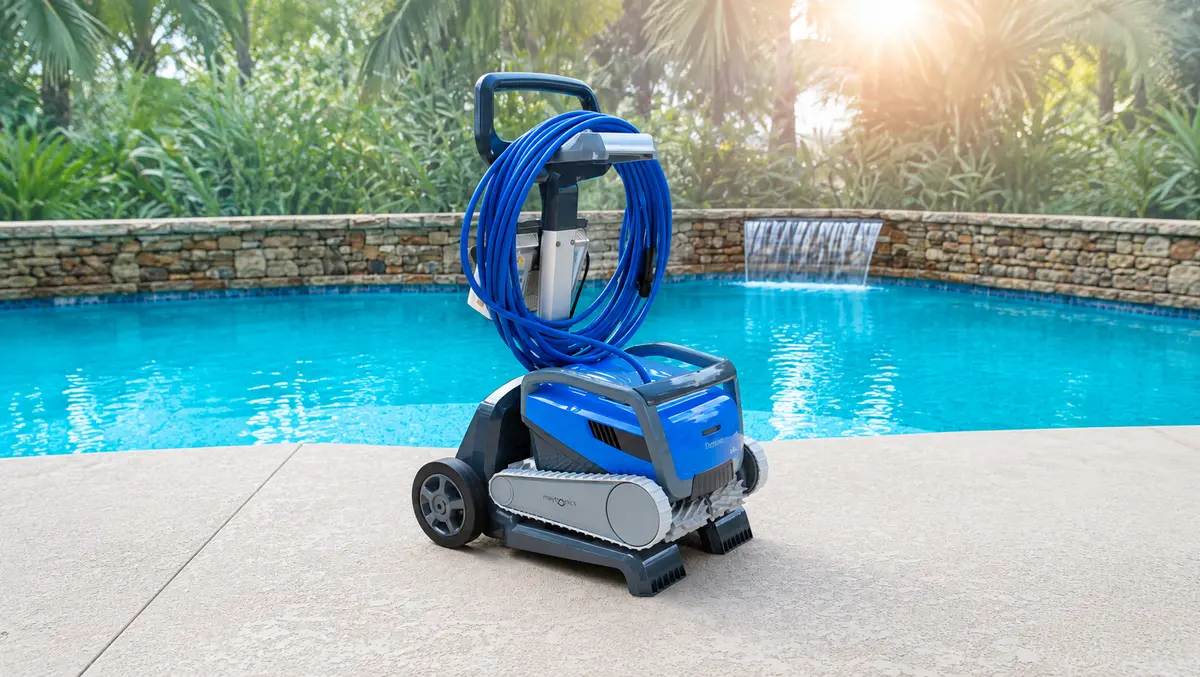
The engineering of robotic pool cleaners: a technical breakdown of the Dolphin M600
Sat, 4th Jul 2026
The robotic pool cleaner is one of the more quietly sophisticated pieces of consumer robotics in the average backyard, yet it rarely attracts the attention given to robot vacuums or autonomous mowers. The category has moved over two decades from simple hydraulic devices to self-contained, microprocessor-driven units that regulate their own power draw, scan their environment and report faults to a smartphone. The Maytronics Dolphin M600, a current flagship in a range widely distributed in Australia, is a useful worked example of where the engineering now sits.
The maintenance and chemistry connection
Robotic cleaning is mechanical, not chemical, but the two are linked. Removing debris, biofilm and fine sediment lowers the organic load that chlorine or mineral sanitisers must oxidise, which stabilises water chemistry and can reduce chemical consumption. Even pools running gentler mineral systems built around magnesium and essential earth minerals still depend on regular mechanical cleaning, because no sanitiser removes settled physical debris. Better circulation from a thorough cycle also distributes sanitiser more evenly, a point Australian suppliers such as Aquatune routinely make to owners.
From hydraulic cleaners to independent robots
Early automated cleaners were not robots in any meaningful sense. Suction-side units connected to the pool's skimmer and relied entirely on the main circulation pump to drag a hose around the floor in a semi-random pattern. Pressure-side units worked in reverse, using return-line pressure, often via a dedicated booster pump, to drive a wheeled body and lift debris into an onboard bag. Both were mechanically simple but inefficient, because they tied cleaning to a high-wattage pump and offered little control over coverage.
The modern robotic cleaner severed that dependency. A unit like the M600 operates as a standalone appliance, drawing low-voltage direct current from a poolside power supply that steps mains voltage down through an isolating transformer. This separation from the filtration loop is the single most important design shift in the category. It lets the cleaner run independently of the pump, filter water through its own system and apply onboard computing to the task.
Drive and traction
The M600 uses independent drive motors turning continuous rubber tracks rather than wheels. Tracks have largely displaced wheels in mid and high-end models because they deliver better grip on tiled and fibreglass surfaces and improve wall-climbing performance.
Where the M600 departs from a conventional track-and-impeller layout is its PowerStream system, which uses multi-directional water jets to actively press the unit against vertical surfaces. Instead of relying on suction alone to hold station on a wall, the cleaner directs thrust to maintain constant contact, which improves traction along the waterline and gives the navigation system more predictable handling on the climb. In practical terms it converts some of the pumped water flow into directional force, a neat use of a system that is already moving water for filtration.
Onboard filtration
Filtration is handled within the unit rather than through the pool's sand or cartridge filter. The M600 uses a top-access filter basket, loaded and emptied from above, which is a meaningful ergonomic change from earlier bottom-loading cartridges that had to be removed and inverted. The basket accepts interchangeable media, with a coarse configuration for leaves and larger debris and an ultra-fine configuration that captures finer particulate, down to a level finer than many domestic sand filters achieve.
Maytronics rates the M600's suction at around 25 percent higher than its other Dolphin units. Because this filtration runs in parallel with the pool's own system, the robot reduces load on the main filter and pump, and the increased flow rate shortens the time needed to turn over the water volume in a given cycle.
Navigation and mapping
Navigation is the area of greatest advance. First-generation robots cleaned using pseudo-random logic, changing direction on contact with a wall and trusting probability to cover the floor over a long cycle. This was inefficient and left gaps.
The M600 uses a gyroscope and accelerometer array to track heading and orientation, allowing systematic scanning passes across floor, walls and waterline rather than random wandering. Maytronics markets this as a scanning algorithm that builds an internal model of the pool and estimates its dimensions during an initial pass, conceptually similar to the mapping done by indoor robot vacuums. The comparison has limits, because localisation underwater is difficult; optical and radio methods are unreliable below the surface, so the system leans on inertial sensing rather than genuine vision. Supporting sensors detect the waterline so the unit scrubs the tile band and reverses before breaching it, and motor-load sensors detect blockages and adjust impeller behaviour to maintain suction.
Connectivity and handling
The M600 pairs over its app, MyDolphin Plus, for weekly scheduling, cycle selection, fault diagnostics and a manual drive mode that steers the unit using an on-screen joystick. The diagnostic reporting has real value, identifying impeller jams and power-supply faults remotely and reducing service callouts. A surfacing function, marketed as Pick-Me-Up, drives the unit to the waterline at the end of a cycle so it can be lifted out without reaching into the pool.
The M600 remains a corded unit. PowerStream and a swivel reduce cable tangling rather than removing the cable, so the floating lead and the poolside transformer are still part of the system.
Where the technology is heading
The clearest forward trend is the move away from the floating cable entirely. Cordless cleaners powered by rechargeable lithium-ion packs remove the cable and transformer, navigating with water-pressure or ultrasonic surface sensors, though run time and recharge cycles remain the main engineering constraint. The M600 sits a step behind that shift, as a corded benchmark whose strengths are suction, traction and filtration rather than battery autonomy. Beyond cordless operation, the near-term direction is tighter integration with broader pool automation, including variable-speed pumps, dosing systems and water-chemistry sensors that increasingly report to the same apps. For now the M600 is best understood as a competent, well-engineered single-purpose robot whose job description has not changed at all, even as the machinery doing it has.