

HTC VIVE launches Eagle AI smart glasses in Australia
Fri, 4th Sep 2026
HTC VIVE has launched its VIVE Eagle AI smart glasses in Australia, entering the local smart eyewear market at AUD $799.
The glasses combine AI assistance with camera and translation functions in a wearable format, with privacy controls central to the design. They include a visible recording light that adjusts to different conditions and blocks recording if the indicator is covered or the glasses are not being worn.
That approach targets a key concern around smart glasses, where discreet recording has drawn scrutiny from consumers and regulators. HTC VIVE also aims to differentiate the product by stating that VIVE AI does not use user data to train AI models.
Users can switch between Google Gemini and OpenAI GPT through the VIVE Connect app, with requests sent to those third-party AI services de-identified.
According to HTC VIVE, VIVE Eagle supports image-to-text translation in more than 70 languages and live translation in more than 90. The glasses can also be used for meeting notes through audio recording and the company's VIVE AI Notes service.
The device has a 12MP ultra-wide camera and supports HDR photography, 1512 x 2016 video at 30 frames per second, and slow-motion capture. Users can take photos and video either by voice command or with a physical capture button.
Privacy focus
HTC VIVE says the product stores photos and videos locally in encrypted form, allowing users to decide whether to move that content to the VIVE Connect app or a cloud-connected photo service. The AI service is described as certified to ISO 27001 and ISO 27701 standards for privacy and security management.
The glasses also include a voice command that allows nearby people to say "stop filming" to end a recording. A multi-sensor system enforces the recording safeguards.
Cher Wang, Co-Founder and Chairperson, HTC, said, "Technology should free our imaginations, and allow us to create and experience and improve our lives. VIVE Eagle is where style meets intelligence, it taps into powerful AI tools and frees your hands so you can be more present in the moment. You can explore new cultures, learn about paintings in galleries, and share your adventures effortlessly."
Wearable push
The launch expands HTC VIVE's consumer hardware range beyond its established virtual and extended reality products. Smart glasses have become an increasingly contested category as technology groups look for new ways to deliver AI services outside the smartphone.
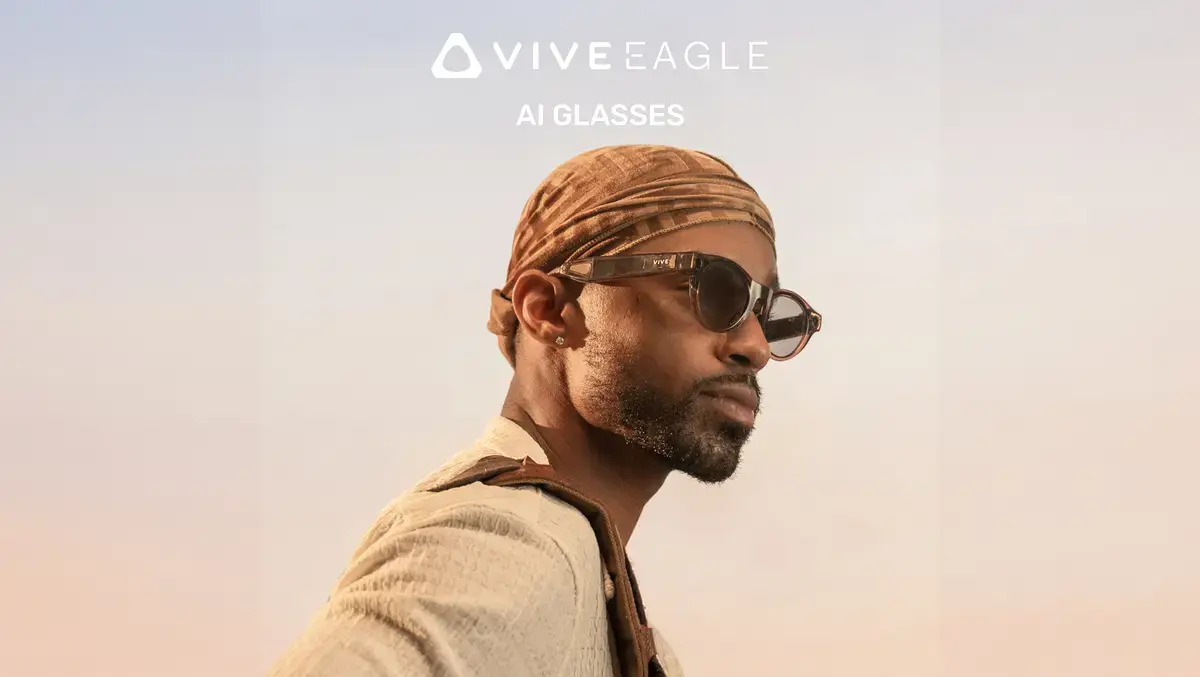
HTC VIVE is positioning VIVE Eagle as everyday eyewear rather than a specialist gadget. The range includes Square and Pantos styles, with clear, sun, and adaptive ZEISS lens options. Prescription lenses are supported through a partnership with Lenswap.
Audio features include open-ear directional speakers and four built-in microphones. The glasses also have an IP54 rating for dust and water resistance.
Battery and sales
HTC VIVE says the glasses provide between four and six hours of active use and up to 36 hours on standby. The magnetic charging design allows use while charging, while fast charging takes the battery to 50% in 10 minutes and 80% in 23 minutes.
An optional VIVE Power Boost battery bank will be sold separately for AUD $79. The accessory weighs 8 grams and can provide up to 80% additional battery life.
VIVE Eagle is available for pre-order through HTC VIVE's online store and will go on wider sale through Amazon and selected Harvey Norman stores. It will be offered in Black, Coffee, Berry, Charcoal Black, Clear Brown, and Navy, depending on the style and lens combination.
Eligible purchases also include access to VIVE AI Plus for two years through the VIVE Connect app, while every commercially sold box in Australia will include a voucher linked to HTC VIVE's prescription lens arrangement with Lenswap.
The launch places HTC VIVE in a segment where device makers are trying to prove AI wearables can be useful in daily life without creating new privacy concerns.