

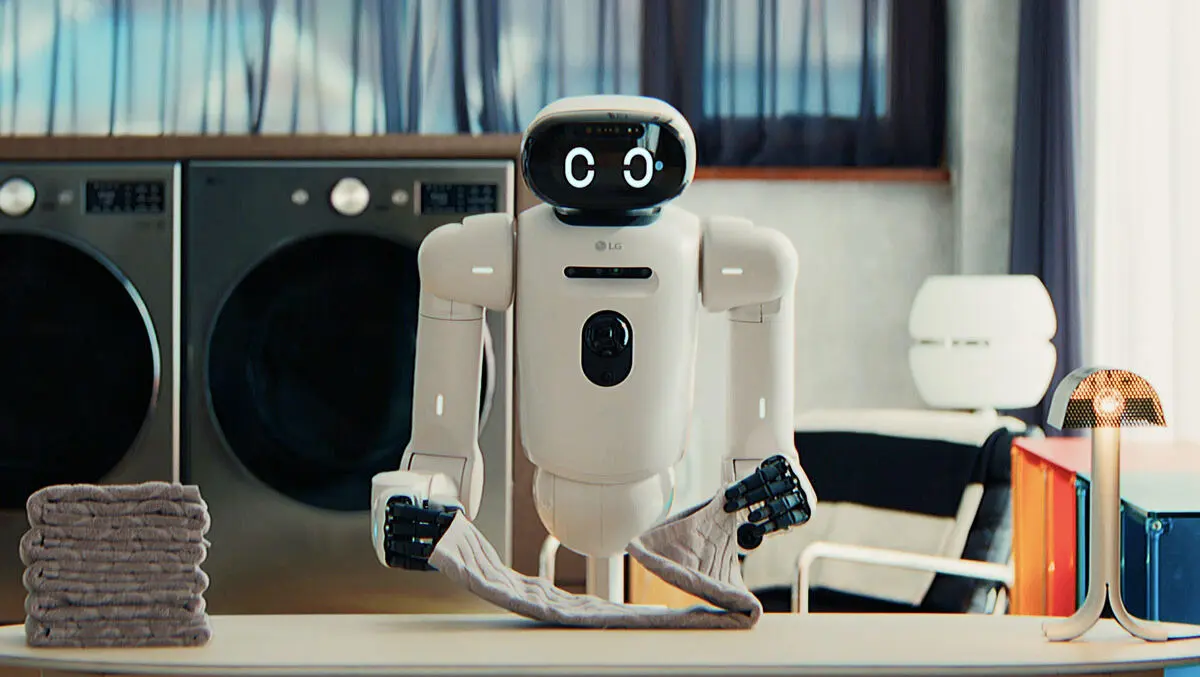

LG Electronics has unveiled a new AI-powered home robot, LG CLOiD, at CES 2026 in Las Vegas as the centrepiece of its "Zero Labour Home" vision for automated domestic work.
The company will demonstrate the robot in a series of domestic scenarios. The system links robotics, artificial intelligence and LG's ThinQ smart home platform. LG positions the device as a co-ordinator of multiple household tasks across connected appliances.
Household scenarios
LG plans to show LG CLOiD working in simulated homes during the trade show. In one demonstration, the robot retrieves milk from a refrigerator and places a croissant in an oven as part of a breakfast routine. In another, it starts laundry cycles once occupants leave and later folds and stacks garments after drying.
The company says these examples reflect the robot's ability to recognise user routines and interact with a range of appliances. LG CLOiD links with compatible products through the ThinQ platform and the ThinQ ON hub.
The launch follows earlier LG efforts in AI home systems, including its Self-Driving AI Home Hub, known as LG Q9. LG now places LG CLOiD as a more physically capable addition to that smart home strategy.
Humanoid form factor
LG CLOiD uses a humanoid-style body. It has a head unit, a torso with two articulated arms and a wheeled base that relies on autonomous navigation technology developed from LG's robot vacuum and LG Q9 work.
The torso tilts so the robot can adjust its height. This allows it to pick up objects from knee level and above. LG says this range supports operation in kitchens, laundry rooms and living areas.
Each arm offers seven degrees of freedom. Joints at the shoulder, elbow and wrist move forward and backward and also move laterally and rotationally. Each hand includes five independently driven fingers. LG states that this permits fine manipulation and handling of a range of household objects.
The wheeled base sits low to the ground to reduce the risk of tipping if a child or pet bumps into the robot. LG cites stability, safety and cost as the main reasons for choosing wheels instead of legs.
Mobile AI hub
The robot's head operates as a mobile AI home hub. The unit houses the main chipset along with a display, speaker, cameras and several sensors. It also includes a voice-based generative AI system.
LG says these components allow LG CLOiD to converse with users, display on-screen "facial expressions" and learn household layouts and lifestyle patterns. The robot uses that understanding to send commands to other LG devices through the ThinQ ecosystem.
LG describes the approach as an extension of its connected home products into mobile robotics. The system acts as both a physical actor in the home and a controller of static appliances.
Physical AI models
At the core of LG CLOiD is what the company calls Physical AI. This combines a Vision Language Model, or VLM, and a Vision Language Action model, or VLA.
The VLM converts images and video into structured, language-based descriptions. The VLA translates those visual and verbal inputs into specific physical actions. LG says it has trained these models on tens of thousands of hours of household task data. The training set includes appliance use and everyday interactions with domestic objects.
This approach allows the robot to recognise appliances, interpret user instructions and carry out context-aware actions. Examples include opening doors and transferring items between devices.
New actuator brand
LG is pairing the robot launch with the introduction of LG Actuator AXIUM, a new brand for its robotic joint components. An actuator integrates a motor that generates rotational force, an electronic drive and a reducer for speed and torque control.
LG calls actuators a strategic upstream technology in the emerging Physical AI segment. The company draws on motor and component design from its appliance business for the new range. It highlights a focus on compact and lightweight construction, efficiency and torque.
LG also promotes a modular design approach for AXIUM actuators. This targets customisation and multi-variety production for advanced robots that can use dozens of different actuator types.
AI home roadmap
LG plans further home robots with different forms and specific functions for housework. The company also intends to embed more robotics into existing product lines. It groups these concepts into "Appliance Robots", such as robot vacuums, and "Robotised Appliances", such as refrigerators with doors that open automatically when someone approaches.
LG frames these developments as steps toward homes where AI-based systems handle most domestic chores and residents spend less time on manual tasks.
Steve Baek, President of the LG Home Appliance Solution Company, said the design aim is for the robot to integrate into everyday life.
"The LG CLOiD home robot is designed to naturally engage with and understand the humans it serves, providing an optimised level of household help," said Steve Baek, president of the LG Home Appliance Solution Company. "We will continue our relentless efforts to achieve our Zero Labour Home vision, making housework a thing of the past so that customers can spend more time on the things that really matter."
LG will present LG CLOiD across several real-life scenarios at its CES 2026 booth in the Las Vegas Convention Centre.