


Wearable tech is now firmly mainstream. Roughly one-third of Australians and around one-quarter of New Zealanders use a smartwatch or wearable device today.
For many, the appeal is simple: tracking health and fitness. From serious athletes chasing personal bests to everyday users trying to close their activity rings or hit 10,000 steps, these devices have become embedded in our everyday lives.
But there's a growing trade-off. Smartwatches add another screen to an already screen-heavy world - and that's the problem Google's Fitbit Air is designed to solve.
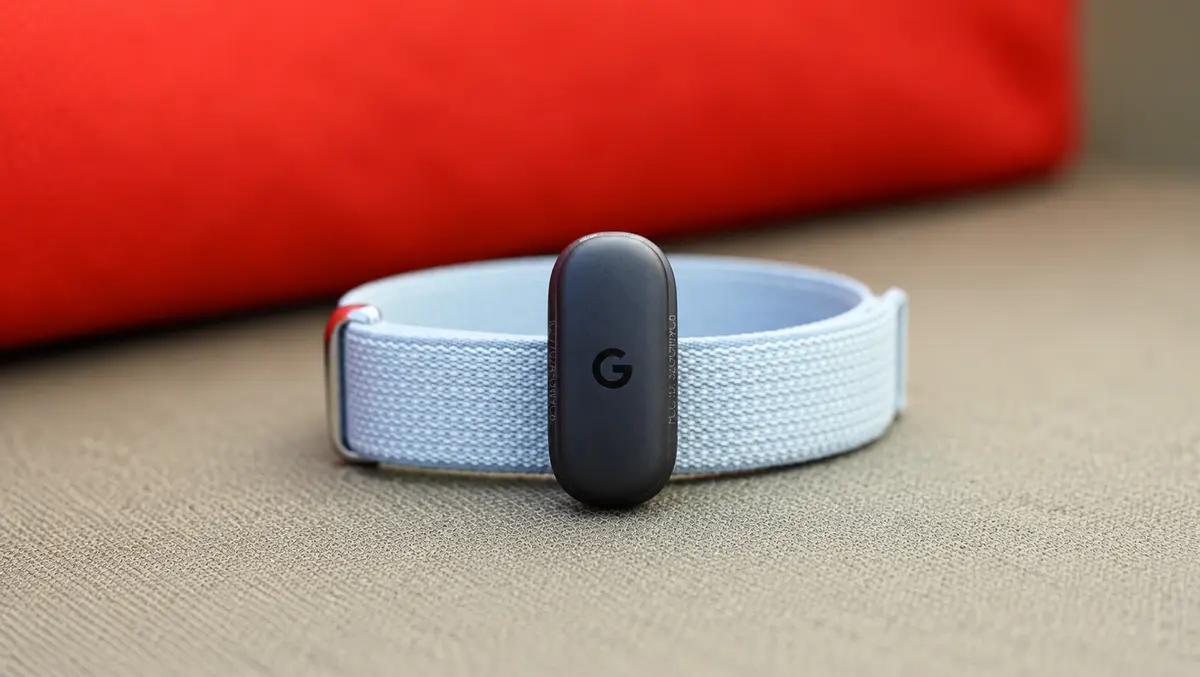
The Fitbit Air is a lightweight, screenless wearable that pairs with your smartphone and focuses purely on continuous health tracking rather than on-wrist interaction.
At $239 NZD (or $199 AUD), it's also priced towards the entry-level market. This could encourage those who've previously been reluctant to buy into the smartwatch category to finally take the plunge.
First impressions and setup
The Google Fitbit Air comes in compact, minimalist cardboard packaging. Inside you'll find the tracker, a wristband and a USB-C charging cable.
Four band colours are available: Obsidian, Lavender, Berry and Fog. We received the Lavender model, which also featured prominently throughout Google's marketing campaign. The bands are interchangeable, with the tracker easily clicking in and out of place in seconds.
Getting the Fitbit Air up and running is straightforward. After placing it on charge, simply download the Google Health app and follow the on-screen prompts to pair the device via Bluetooth 5.0.
The app is full of key information about your health and fitness, particularly if you sign up for Google Health Premium - but more on that later.
The Fitbit Air is incredibly light at just 12g and around 18mm wide. After a couple of minutes, you forget it's on your wrist - ideal for those who don't want another distraction.
Material-wise, the tracker is constructed from recycled polycarbonate and PBT plastics, while the band is made of a soft fabric with Velcro and sports a stainless-steel buckle.
Living with the Google Fitbit Air
Using the Fitbit Air daily for around two weeks, I found myself adjusting to life without a screen much quicker than I expected.
I used it on my dominant wrist to compare it to my personal smartwatch - the Apple Watch Series 11.
I found the Fitbit Air slightly more consistent for sleep tracking and step counting, and I rarely reached for my Apple Watch during the day beyond checking the time.
The big difference between the Fitbit Air and some of the more premium offerings from the likes of Samsung and Apple is the lack of necessity to charge it daily.
Google claims up to seven days of battery life, though I consistently achieved around five days in real-world use before recharging. Battery life can be quickly checked via the companion app or a simple double-tap on the device, which triggers a status light: white indicates above 20 per cent, while red signals it's time to charge. A full charge takes around 90 minutes, with a five-minute top-up providing roughly a day of use.
A good time to charge the device would be while you're getting ready or showering, but you don't have to remove it while you're getting washed as it has a 5 ATM water rating - meaning it's suitable for swimming and showering, but not diving.
Another thing I loved about the Fitbit Air was not having to choose between a nice dress watch and a smartwatch - you can wear both at the same time (even on the same wrist) without looking silly.
The app and Google Health Premium
As mentioned earlier, the app is full of data that could keep you busy for hours, but subscribing to Google Health Premium allows you to get so much more out of the device.
Without Premium, you still get your basic fitness tracker capabilities like your activity, step count, heart rate and sleep tracking. However, if you pay the $16.99 NZD ($14.99 AUD) per month or $149.99 NZD ($149.99 AUD) per year, you get a whole lot more.
Adaptive fitness plans, deeper sleep coaching and proactive insights are among the features unlocked with Premium, but the standout is Google Health Coach - a Gemini-powered AI assistant that delivers personalised advice based on your activity. It can suggest practical adjustments to your routine, such as when to exercise based on sleep quality or even weather conditions.
It's worth noting that the Fitbit Air comes with a free three-month trial of Google Health Premium so you can see if it's right for your needs.
Verdict
The Google Fitbit Air really could be that device that gets more people into wearables. It shouldn't necessarily be compared to the likes of the Apple Watch and Samsung Galaxy Watch as it serves a very different purpose.
The screenless tracker also isn't an entirely new concept - WHOOP has operated in this space for years - but Google's advantage lies in its price, accessibility and integration with its standout app.
That said, much of the experience is enhanced by Google Health Premium, which adds meaningful depth through AI-powered coaching and personalised insights. Without it, the device is a capable but rather passive health tracker.
Google has seen a gap in the market, and it has every chance of being a high-selling product.
For users who want to reduce their screen time but still track health and fitness accurately, the Fitbit Air is one of the most compelling screenless wearables available right now.