

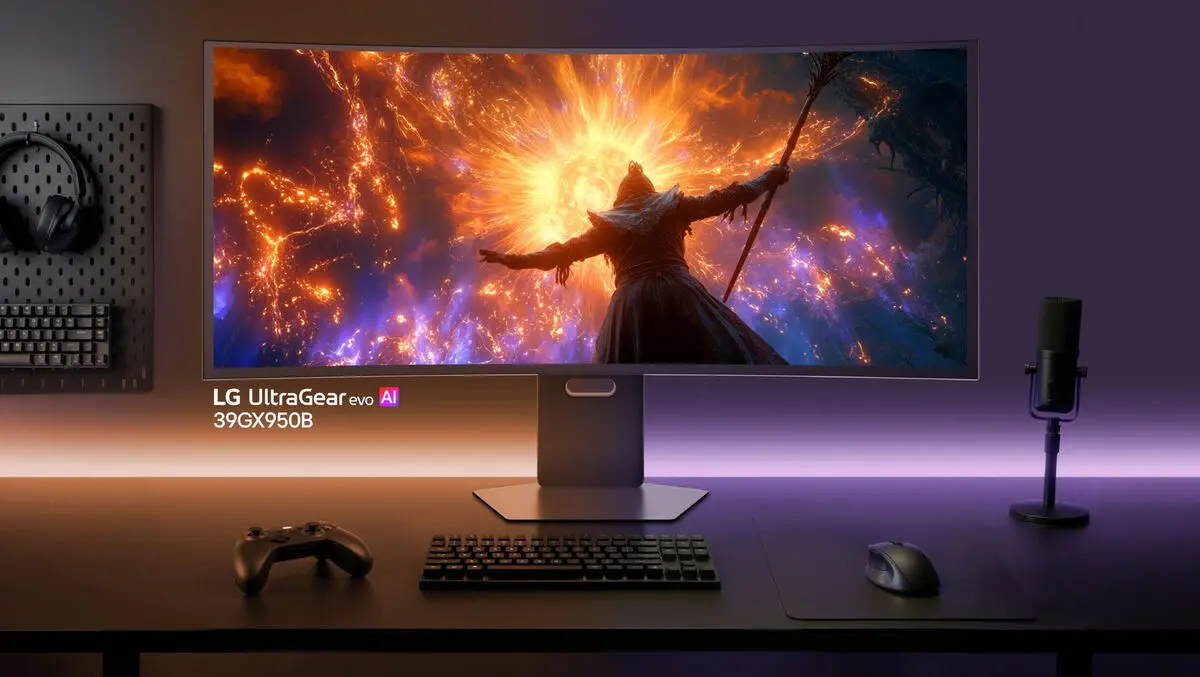
LG unveils UltraGear evo 5K AI gaming monitor lineup
Tue, 30th Dec 2025
LG has launched a new premium gaming monitor brand, UltraGear evo, unveiling three flagship 5K and 5K2K models that use on-device artificial intelligence to upscale lower-resolution content without relying on more powerful graphics hardware.
The South Korean electronics group plans a global rollout of the UltraGear evo range, which will make its public debut at CES 2026. The initial line-up spans OLED, new MiniLED and ultra-wide formats and targets PC gamers who want higher resolutions, faster refresh rates and larger screen sizes.
The three new monitors are the 39GX950B OLED, the 27GM950B MiniLED and the 52G930B ultra-wide. All three deliver resolutions at or above 5K and support high refresh rates that are aimed at competitive play.
LG has focused on a new on-device AI system in two of the models, the 39GX950B and 27GM950B. The company said this underpins what it describes as the world's first 5K AI Upscaling technology. The monitors process content locally and upgrade image sharpness to what LG calls "5K-class" clarity, which reduces the need for users to upgrade their GPUs to drive native 5K.
The AI system also includes AI Scene Optimisation and AI Sound functions. These features analyse visuals and audio in real time and adjust parameters such as detail, contrast and sound profile based on the content.
39-inch OLED
The UltraGear evo 39GX950B is a 39-inch 5K2K OLED gaming monitor. It continues LG's GX9 series in a new specification that combines high resolution with a curved, ultra-wide design. The model has a 21:9 aspect ratio with a 1500R curvature and keeps the vertical height of a 32-inch screen while extending the horizontal field of view.
LG uses its Primary RGB Tandem OLED panel technology in the 39-inch model. The company said this improves brightness, colour accuracy and panel longevity. The display achieves deep blacks and high contrast and has VESA DisplayHDR True Black 500 certification.
The monitor supports a Dual Mode feature. Users can run it at 5K2K resolution with a 165Hz refresh rate, or switch to WFHD resolution with a 330Hz refresh rate. LG quotes a grey-to-grey response time of 0.03ms, which is aimed at reducing motion blur in fast-paced games.
The 39GX950B has a pixel density of 142 pixels per inch. LG positions this as suitable for both immersive gaming and multitasking, with additional horizontal workspace compared with standard 16:9 displays.
27-inch MiniLED
The UltraGear evo 27GM950B introduces a 27-inch 5K MiniLED monitor that LG said addresses blooming, which is a halo effect that appears around bright objects on dark backgrounds. The panel uses 2,304 local dimming zones and what LG calls Zero Optical Distance engineering. This reduces the gap between the panel and the backlight in an effort to sharpen images and control light bleed between zones.
The 27-inch model also includes the on-device AI solution with 5K AI Upscaling, AI Scene Optimisation and AI Sound. These functions run on the monitor itself and do not add processing load to the gaming PC.
The 27GM950B supports Dual Mode operation. It can run at 5K resolution with a 165Hz refresh rate, or at QHD resolution with a 330Hz refresh rate. The response time is rated at 1ms (grey-to-grey).
The display is VESA DisplayHDR 1000 certified. LG said it can reach peak brightness of up to 1,250 nits and display highlights such as flames or flashes of light with more detail, while maintaining darker areas through its MiniLED-based local dimming.
52-inch ultra-wide
The third model, the UltraGear evo 52G930B, is a 52-inch 5K2K gaming monitor with a 240Hz refresh rate. LG said it is the world's largest 5K2K gaming monitor. The screen uses a 12:9 aspect ratio and a 1000R curve which wraps more of the user's field of view.
The vertical viewing height matches that of a standard 42-inch 16:9 display. The horizontal width extends the workspace to 33 per cent more than a 16:9 UHD monitor. LG targets this at users who want both panoramic gaming and a wider desktop for productivity.
The 52-inch display supports VESA DisplayHDR 600. It provides higher peak brightness than SDR displays and stronger contrast between bright and dark areas, which LG positions as suitable for both games and media consumption.
Strategic focus
UltraGear is LG's specialist gaming brand in monitors. The new evo label sits at the top end of that line and concentrates on 5K and above resolutions. The company is expanding into larger sizes and higher refresh rates as game developers introduce titles with more detailed graphics and as esports competition continues to grow.
Lee Choong-hwoan, Head of the Display Business at the LG Media Entertainment Solution Company, said the new range changes the trade-offs users face when buying gaming displays.
"The new UltraGear evo marks a definitive turning point, signaling the end of compromises in gaming display performance. With innovations like industry-first 5K AI Upscaling, the lineup ensures that whether gamers prefer perfect blacks, unmatched brightness, or expansive scale, they can enjoy the same high standard of performance, clarity and immersion in high resolution" said Lee Choong-hwoan, head of the Display Business at the LG Media Entertainment Solution Company. "This reflects our excellence in delivering high-resolution technology not only to the B2C gaming market but also through precision-driven B2B solutions like medical monitors."
LG will show the UltraGear evo range at CES 2026 in two demonstration zones. One will feature a gaming "Dream Setup" influenced by Reddit gaming communities. The other will use a SimCraft racing simulator built around the new 39-inch GX9 monitor.
Alongside the evo line, LG will start global sales of the UltraGear GX7 (27GX790B) during CES. The 27-inch monitor uses a QHD Primary RGB Tandem OLED panel and a 540Hz refresh rate. It also supports a Dual Mode that reaches 720Hz at HD resolution, which targets esports players who prioritise frame rate.